



 37 / 121

Javier Larrea/Pixtal/age fotostock
Cycles in the Biosphere
The law of conservation of mass states that
matter is not created or destroyed. All new life
on the Earth is built from existing atoms. There-
fore, natural processes cycle matter through the
biosphere.
Matter
—anything that takes up space
and has mass—provides the nutrients needed for
organisms to function. A
nutrient
is a chemical
substance that an organism must obtain from its
environment to sustain life. All organisms
contain water and nutrients such as carbon,
nitrogen, and phosphorus.
The exchange of matter through the biosphere
is called a
biogeochemical cycle.
These cycles
involve living organisms (
bio
), geological
processes (
geo
), and chemical processes (
chemi-
cal
). Chemical elements that make up the
molecules of organisms pass through food webs
and biogeochemical cycles, combining and
recombining in different ways.
CHEMISTRY
Connection
Refer back to
the energy and biomass pyramids in
Figure 16
.
At each link upward in a food web, only a
fraction of the matter and energy consumed is
transferred to produce growth and release
energy in cellular respiration at the higher level.
Given this inefficiency, fewer organisms are
found at higher levels of the food web.
Algae and plants are the lowest level of the food
chain. As the matter and energy move through
an ecosystem like that in
Figure 17
, some
matter reacts to release energy for life func-
tions, some is stored, and much is discarded.
Regardless of how the matter and energy
change, they are conserved.
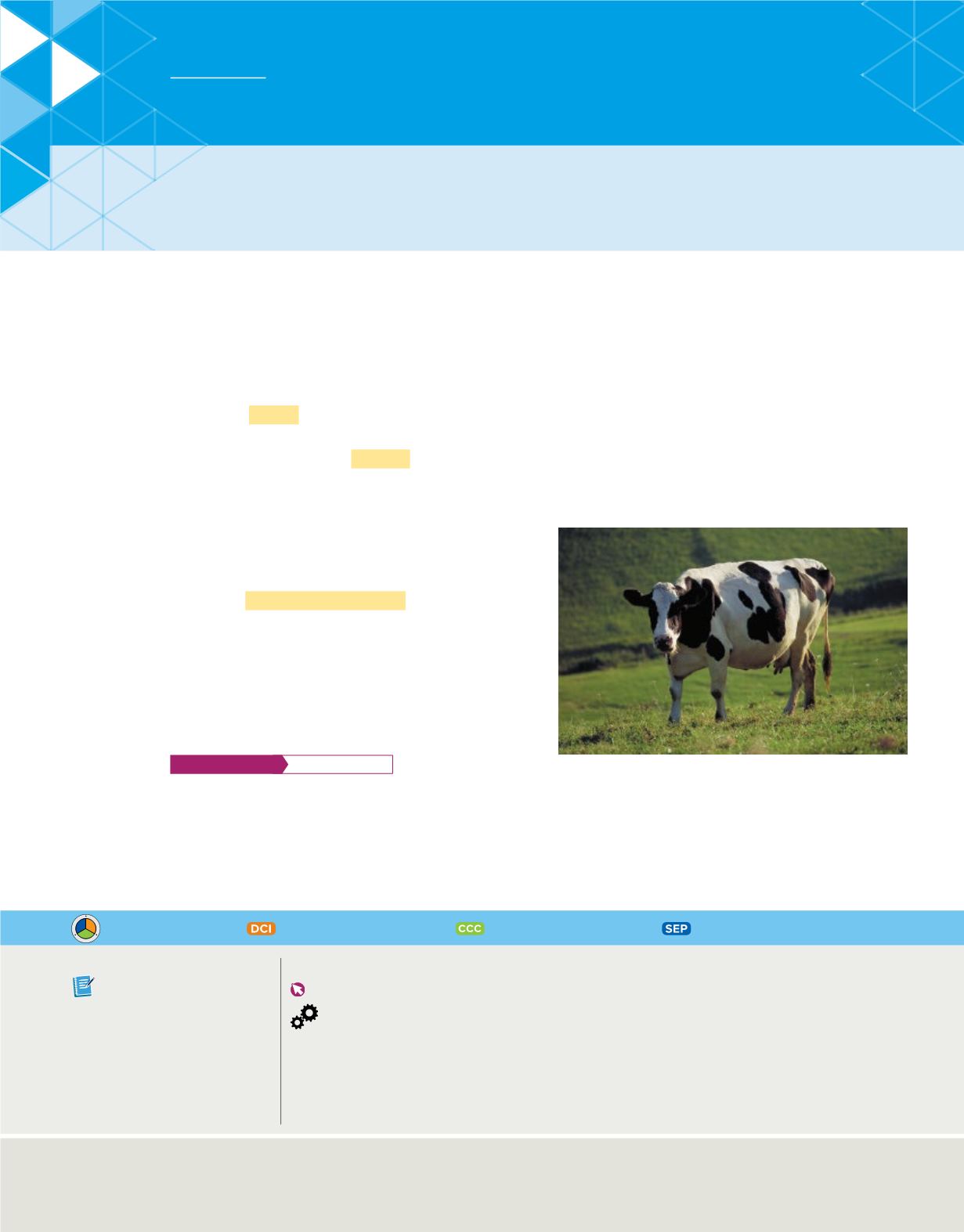
Figure 17
Chemical elements are cycled through the
biosphere through organisms. As producers, grasses begin
the cycle by capturing energy from the Sun.
Explain
how chemical elements continue to be cycled
through the biosphere in this photo.
LESSON 3
CYCLING OF MATTER
FOCUS QUESTION
How does matter flow through an ecosystem?
Disciplinary Core Ideas
Science & Engineering Practices
3D THINKING
C
C
C
S
E
P
D
C
I
COLLECT EVIDENCE
Use your Science Journal to
record the evidence you collect as
you complete the readings and
activities in this lesson.
INVESTIGATE
GO ONLINE
to find these activities and more resources.
Applying Practices:
The Cycling of Matter and Flow of Energy in Aerobic and
Anaerobic Conditions
HS-LS2-3.
Construct and revise an explanation based on evidence
for the cycling of
matter
and flow of energy
in aerobic and anaerobic conditions.
Crosscutting Concepts
Lesson 3 • Cycling of Matter
39