


 34 / 121

Plant
Grasshopper
Mouse
Snake
Producer
Herbivore
Omnivore
Carnivore
RNMitra/iStock/Getty Images
Organisms that eat both plants and animals are
called
omnivores
(AHM nih vorz). Bears, humans,
and mockingbirds are examples of omnivores.
The
detritivores
(duh TRYD uh vorz) eat frag-
ments of dead matter in an ecosystem, returning
nutrients to the soil, air, and water. Detritivores
include worms and many aquatic insects that live
on stream bottoms. Decomposers, similar to
detritivores, break down dead organisms by
releasing digestive enzymes. Fungi, such as those
in
Figure 13
, and bacteria are decomposers.
All heterotrophs perform some decomposition
when consuming another organism. The primary
role of decomposers is to break down organic compounds and make nutrients available
to producers. Without the presence and activities of detritivores and decomposers,
organic material and the nutrients would not be available to other organisms to reuse.
Models of Energy Flow
Ecologists use food chains and food webs to model the energy
flow through an ecosystem. Food chains and food webs are
simplified representations of the flow of energy. Each step in a
food chain or food web is called a
trophic
(TROH fihk)
level.
Autotrophs make up the first trophic level in all ecosystems.
Heterotrophs make up the remaining levels. With the exception
of the first trophic level, organisms at each trophic level get their
energy from the trophic level before it.
Food chains
A
food chain
is a model that shows how energy flows through an
ecosystem.
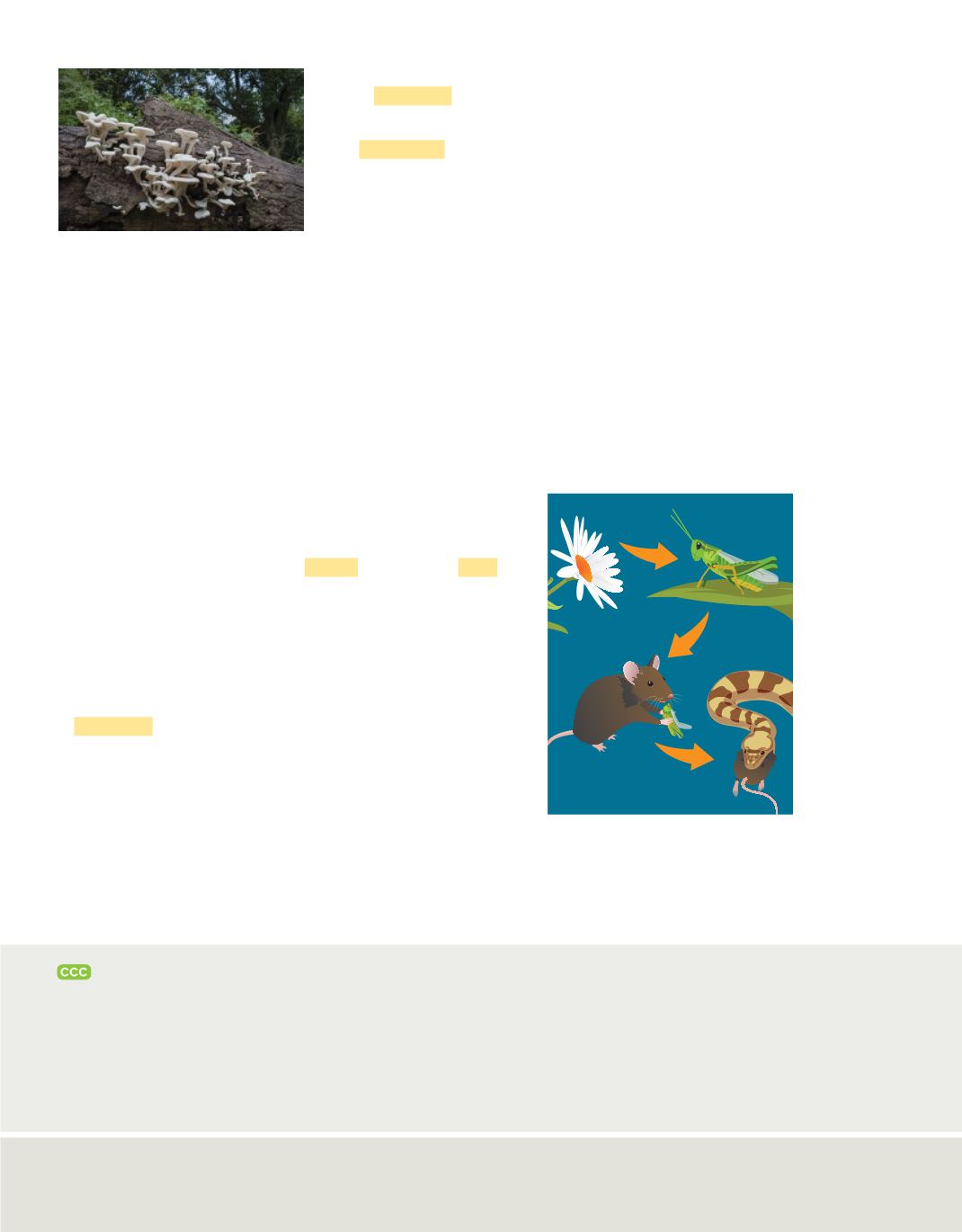
Figure 14
shows a typical grassland food chain.
Arrows represent the energy flow, which typically moves from
autotrophs to heterotrophs. The flower uses energy from the Sun
to make its own food. The grasshopper obtains energy from
eating the flower. The mouse obtains energy from eating the
grasshopper. Finally, the snake gains energy from eating the
mouse. At each step in the food chain, some energy is used for
cellular processes and to build new cells and tissues. Some energy is
released into the environment.
Figure 13
This fungus is obtaining food
energy from the dead log. Fungi are
decomposers that recycle materials
found in dead organisms.
Explain
why decomposers are important
in an ecosystem
.
Figure 14
A food chain is a simplified
model representing the transfer of
energy from organism to organism.
CROSSCUTTING CONCEPTS
Energy and Matter
Create a physical model of a food chain that
describes the flow of energy and matter through the system.
36
Module 2 • Principles of Ecology