



 36 / 121

90,000
Secondary
consumers
200,000
Primary consumers
1,500,000
Primary producers
Third-level
consumers
P
o
p
u
l
a
tion size decreases
1.5 g/m
2
Third-level
consumers
11 g/m
2
Secondary
consumers
37 g/m
2
Primary
consumers
809 g/m
2
Primary
producers
A
v
a
i
lable bio
m
ass
d
ec
r
e
as
es
0.1%
Third-level
consumers
Energy lost
as heat
1% Secondary
consumers
10% Primary
consumers
100% Primary
producers
Parasites and decomposers
feed at each level.
A
va
i
l
a
bl
e
energy
d
e
c
r
e
a
s
e
s
Go online to follow your personalized learning path to review, practice,
and reinforce your understanding.
Summary
• Autotrophs capture energy
from the Sun or use energy
from certain chemical sub-
stances to make food.
• Heterotrophs include herbi-
vores, carnivores, omnivores,
and detritivores.
• A trophic level is a step in a
food chain or food web.
• Food chains, food webs, and
ecological pyramids are
models used to show how
energy moves through
ecosystems.
Demonstrate Understanding
1.
Distinguish
producers, consumers, and decomposers
from one another.
2.
Explain
how photosynthesis and cellular respiration
provide energy in each step of a food chain.
3.
Classify
a pet dog as an autotroph or heterotroph and
as an herbivore, carnivore, or omnivore. Explain.
Explain Your Thinking
4.
Create and use
a simple food web to identify produc-
ers, consumers, and decomposers in your community.
5.
Draw
an energy pyramid for a
food chain made up of grass, a caterpillar, tiger beetle,
lizard, snake, and a roadrunner. Assume that 100
percent of the energy is available for the grass. At
each stage, calculate and show how much energy is
lost and how much is available to the next trophic level.
6.
Write a paragraph that
explains the pathway of energy transfer through the
pyramid of energy shown in
Figure 16
.
Check Your Progress
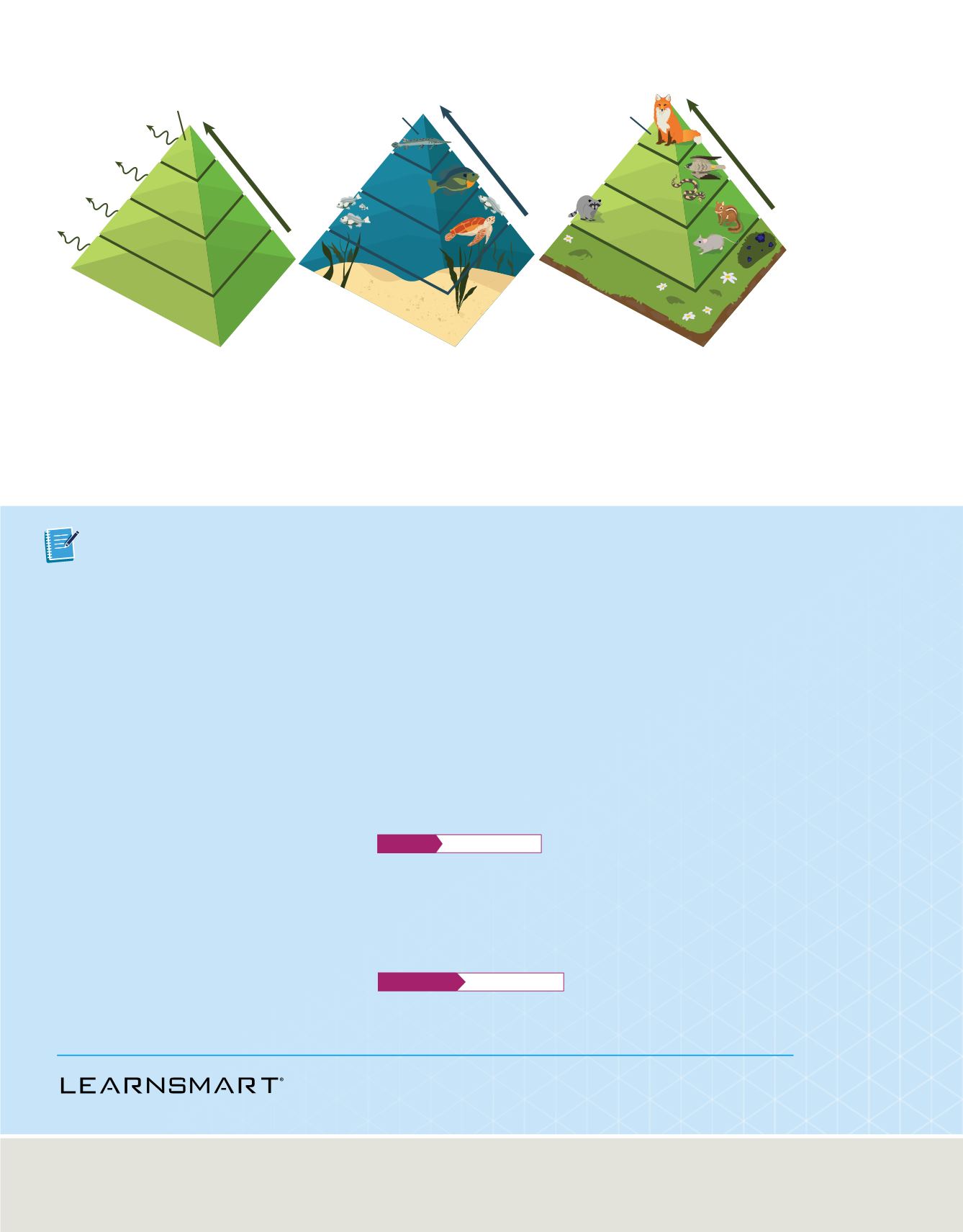
Figure 16
Ecological pyramids are models used to represent trophic levels in ecosystems.
Identify
the process by which autotrophs at the bottom of the pyramid convert energy from the Sun.
As shown in the pyramid of numbers, the relative number of organisms at each trophic
level also decreases because there is less energy available to support organisms. The
ecosystem determines the shape of an ecological pyramid.
MATH
WRITING
Connection
Connection
38
Module 2 • Principles of Ecology