


 30 / 121

(t) SerengetiLion/iStock/Getty Images; (b) Borut Trdina/E+/Getty Images
Ecosystem Interactions
The interactions between organisms are import-
ant in an ecosystem. A community of organ-
isms increases the chances for survival of any
one species by using the available resources in
different ways. If you look closely at a tree in
the forest, like the one shown in
Figure 8
, you
will find a community of different birds using
the resources of the tree in different ways. For
example, one bird species might eat insects on
the leaves while another species of bird might
use pieces of bark as nesting materials. The
chance of survival for the birds increases
because they are using different resources.
The trees shown in
Figure 8
also are habitats.
A
habitat
is an area where an organism lives.
A habitat might be a single tree for an organism
that spends its life on one tree. If the organism
moves from tree to tree, its habitat would be a
grove of trees.
Organisms not only have a habitat—they have
a niche as well. A
niche
(NIHCH) is the role or
position that an organism has in its environ-
ment. An organism’s niche is how it meets its
needs for food, shelter, and reproduction. The
niche might be described in terms of require-
ments for living space, temperature, moisture,
or in terms of appropriate mating or reproduc-
tion conditions.
Community Interactions
Organisms that live together in a biological
community constantly interact. These interac-
tions, along with the abiotic factors, shape an
ecosystem. Interactions include competition for
basic needs such as food, shelter, and mates, as
well as relationships in which organisms
depend on each other for survival.
Competition
Competition occurs when more than one
organism uses a resource at the same time.
Resources are necessary for life and might
include food, water, space, and light. For
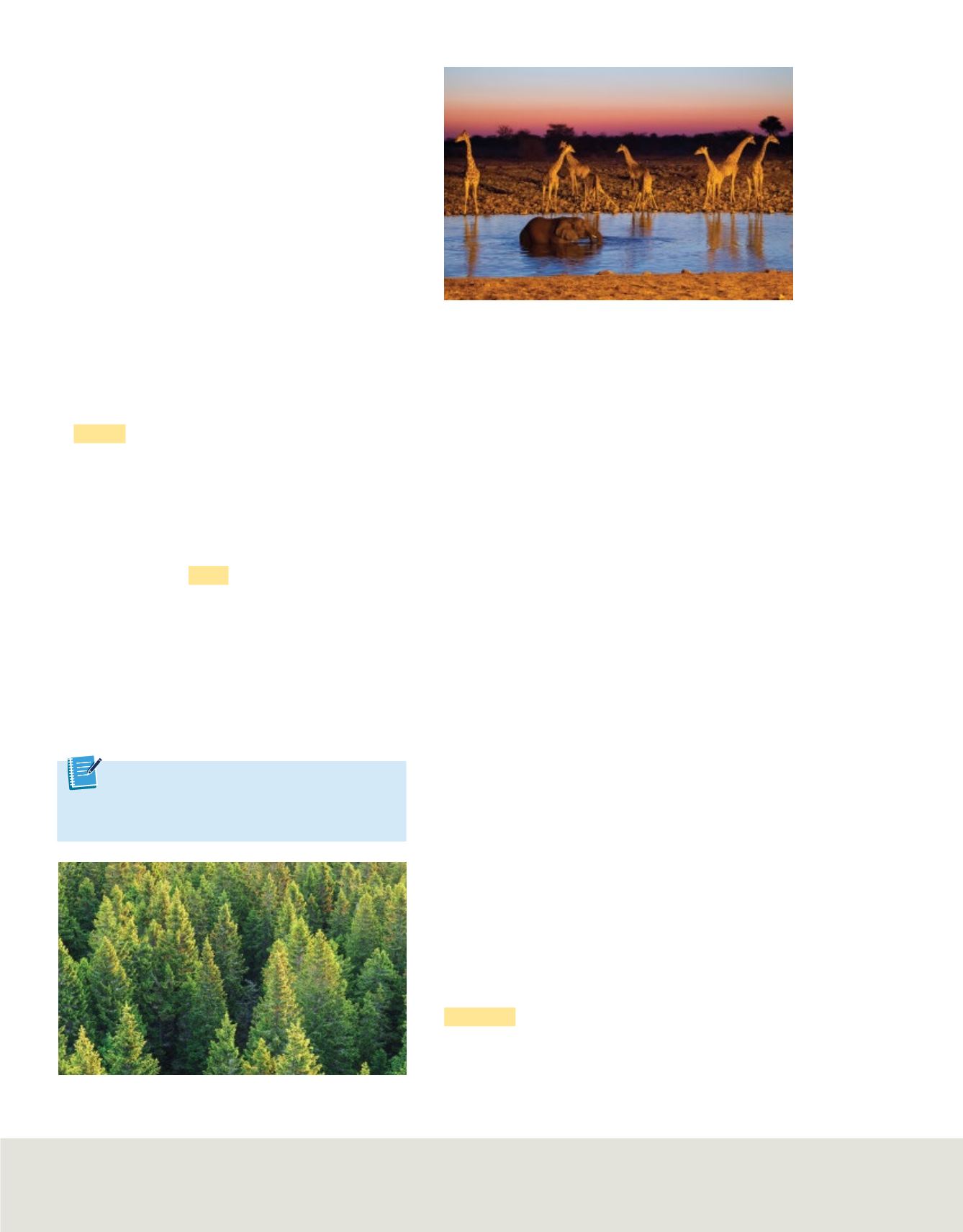
example, during a drought, as shown in
Figure 9
, water might be scarce for many
organisms. The strong organisms directly
compete with the weak organisms for survival.
Usually the strong survive and the weak die.
Some organisms might move to another loca-
tion where water is available. At times when
water is plentiful, all organisms share the
resources and competition is not as fierce.
Predation
Many species get their food by eating other
organisms. The act of one organism pursuing
and consuming another organism for food is
predation
(prih DAY shun). The organism that
pursues another organism is the predator, and
the organism that is pursued is the prey. If you
have watched a cat catch a bird or mouse, you
have witnessed a predator catch its prey.
Figure 9
During droughts, animals compete for water;
when water is plentiful, competition decreases.
Figure 8
These trees are the habitat for the community of
organisms that live in them.
Get It?
Compare and contrast
a habitat and a
niche.
32
Module 2 • Principles of Ecology