


 32 / 121

©Paparazzi by Appointment/Alamy
Go online to follow your personalized learning path to review, practice,
and reinforce your understanding.
Summary
• Ecology is the branch of biol-
ogy that focuses on interrela-
tionships between organisms
and their environments.
• Abiotic and biotic limiting
factors restrict the growth of a
population within a community.
• Organisms have a range of
tolerance for each limiting
factor that they encounter.
• Levels of organization in
ecological studies include
organism, population, biologi-
cal community, ecosystem,
biome, and biosphere.
• Symbiotic relationships such as
commensalism, parasitism, and
mutualism exist when two or
more species live together.
Demonstrate Understanding
1.
Predict
how unfavorable abiotic and biotic factors
affect a species.
2.
Identify
how temperature is a limiting factor for polar
bears.
3.
Describe
how ranges of tolerance affect the distribu-
tion of a species.
4.
Differentiate
between the habitat and niche of an
organism that is found in your community.
Explain Your Thinking
5.
Interpret Figure 6
and predict the general growth
trend for steelhead trout in a stream that is 22˚C.
6.
Graph
the following data to
determine the range of tolerance for catfish. The first
number in each pair of data is temperature in degrees
Celsius; the second number is the number of catfish
found in the stream: (0, 0); (5, 0); (10, 2); (15, 15); (20, 13);
(25, 3); (30, 0); (35, 0). Choose an appropriate scale
and units for your graph.
Check Your Progress
Parasitism
A symbiotic relationship in which
one organism benefits at the expense of
another organism is
parasitism
(PER us suh tih
zum). Parasites can be external, such as ticks
and fleas, or internal, such as bacteria,
tapeworms, and roundworms. In most cases of
parasitism, the parasite does not kill the host,
instead only harming or weakening it. This is
because the death of the host would also mean
the death of the parasite unless it could quickly
find another host. This is not the case of the
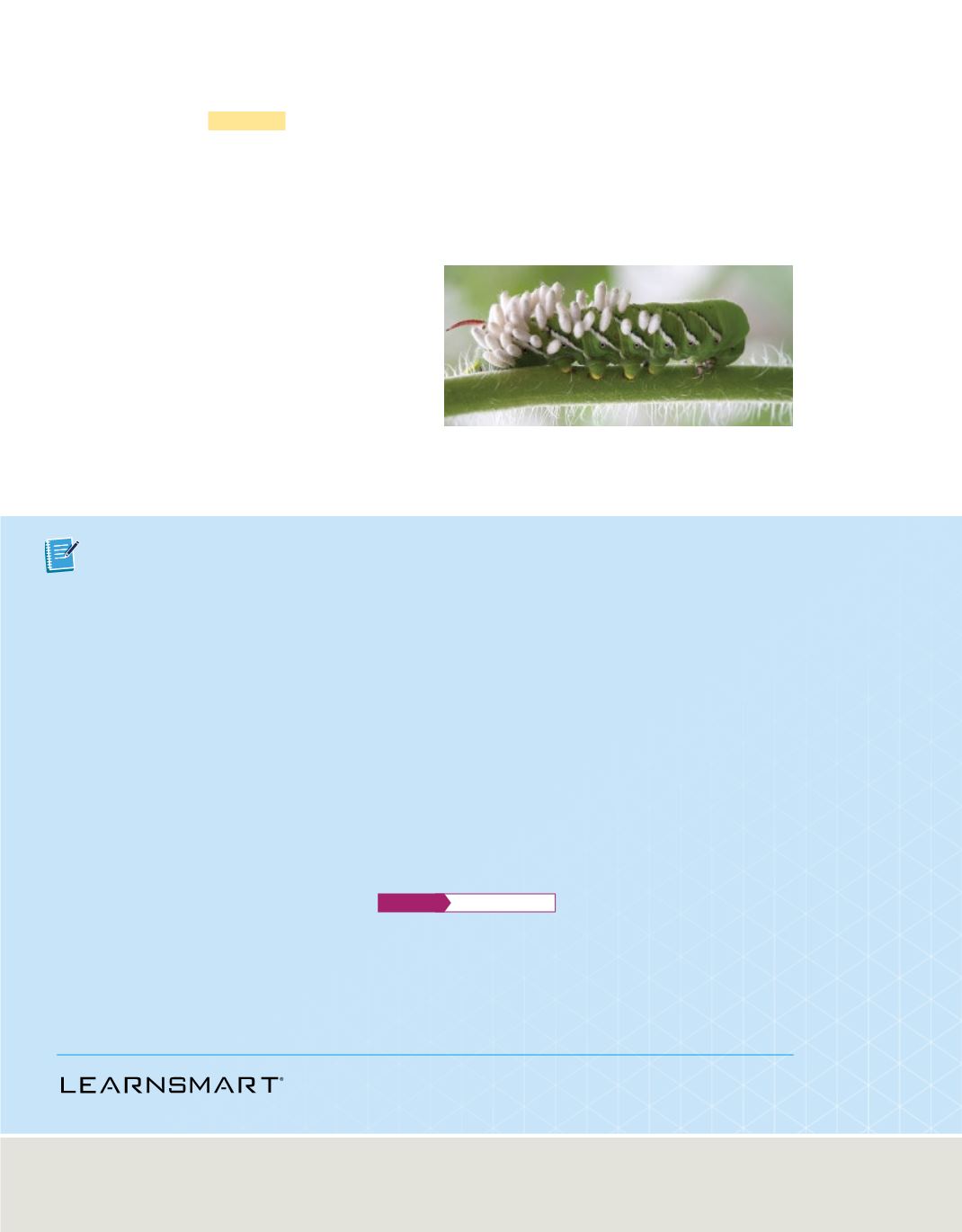
tomato hornworm that is infected with cocoons
of a parasitic wasp in
Figure 11
, because the
pupating wasps will most likely kill their host.
Another type of parasitism is brood parasitism.
Brown-headed cowbirds demonstrate brood
parasitism because they rely on other bird
species to build their nests and incubate their
eggs. A brown-headed cowbird lays its eggs in
another bird’s nest and abandons the eggs. The
host bird incubates and feeds the young cow-
birds. Often the baby cowbirds push the host’s
eggs or young from the nest, resulting in the
survival of only the cowbirds. In some areas,
the brown-headed cowbirds have significantly
lowered the population of songbirds through
this type of parasitism.
Figure 11
This tomato hornworm is host to a number of
pupating parasitic wasps. This case of parasitism is
unusual because the wasps will likely kill their host.
MATH
Connection
34
Module 2 • Principles of Ecology