



 89 / 121

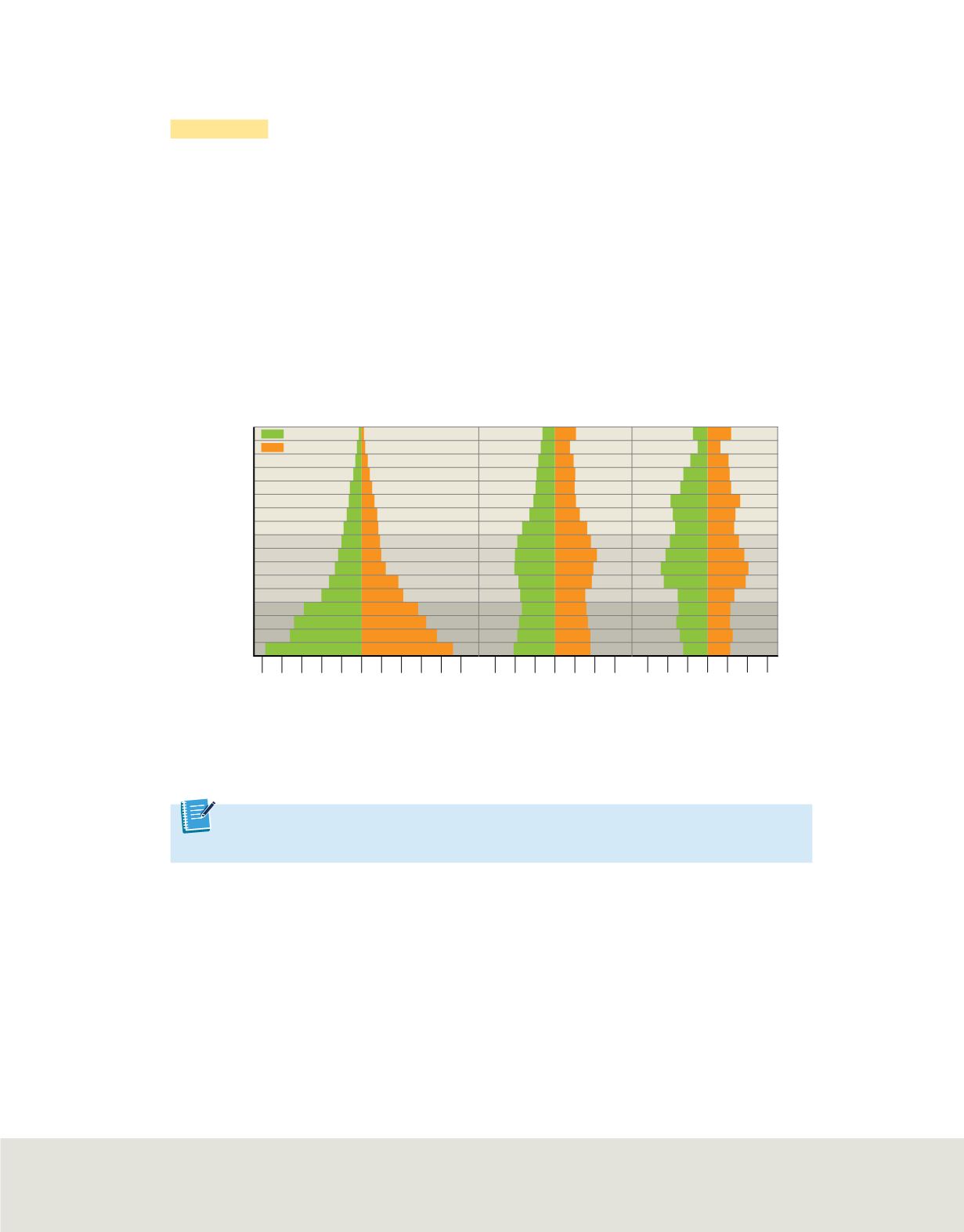
Age Structure in Human Population for 2015
10–14
15–19
5–9
0–4
20–24
25–29
30–34
35–39
40–44
45–49
50–54
55–59
60–64
65–69
70–74
75–79
80–100
Age
Percent of population
0 2 4 6
6 4 2
Percent of population
0 2 4 6
6 4 2
Percent of population
0 2 4 6 8 10
10 8 6 4 2
Pre–reproductive
Post–reproductive
Kenya
United States
Germany
Reproductive
Men
Women
Age structure
Another important characteristic of any population is its age structure. A population’s
age structure
is the number of males and females in each of three age groups: pre-re-
productive stage, reproductive stage, and post-reproductive stage. Humans are consid-
ered to be pre-reproductive before age 20 even though they are capable of reproduction
at an earlier age. The reproductive years are considered to be between 20 and 44, and
the post-reproductive years are after age 44.
Analyze the age structure diagrams for three different representative countries in
Figure 14
. The age structure diagrams are typical of many countries in the world. Notice
the shape of the overall diagram for a country that is rapidly growing, one that is
growing slowly, and one that has reached negative growth. The age structure for the
world’s human population looks more like that of a rapidly growing country.
Figure 14
The relative numbers of individuals in pre-reproductive, reproductive, and post-reproductive
years are shown for three representative countries.
Get It?
Compare and contrast
the age structures of the countries shown in
Figure 14
.
Earth’s carrying capacity for humans
Calculating population growth rates is not just a mathematical exercise. Scientists are concerned
about the human population reaching or exceeding the carrying capacity. As you learned in
Lesson 1, all populations are limited by the carrying capacity of their ecosystems, and the human
population is no exception. Many scientists suggest that human population growth needs to be
reduced. In many countries, voluntary population control is occurring through family planning.
Unfortunately, if the human population continues to grow—as most populations do— and areas
become overcrowded, disease and starvation will occur. However, technology has allowed humans to
increase the carrying capacity of Earth, at least temporarily. It might be possible for technology and
planning to keep the human population at or below Earth’s carrying capacity.
Lesson 2 • Human Population
91