



 72 / 121

–
0.4
–
0.2
0
0.2
0.4
0.6
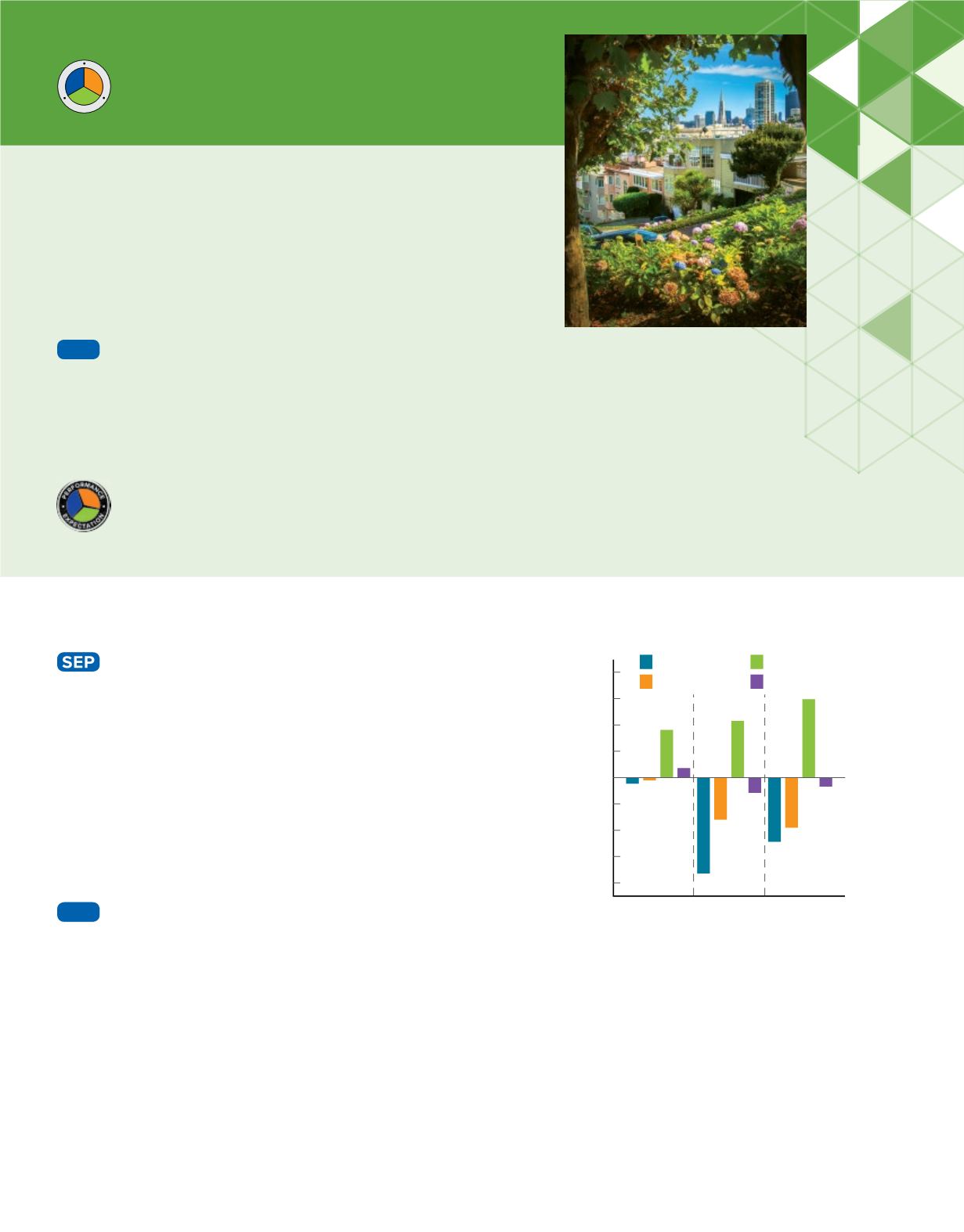
Change in shoot biomass
–
0.6
–
0.8
0.8
4 Months 6 Months 12 Months
Early
Mid-succession
Late
All plants
Time
Succession Progression
Celso Diniz/Alamy Stock Photo
REVISIT THE PHENOMENON
Why would you grow a
garden in a city?
CER
Claim, Evidence, Reasoning
Explain your Reasoning
Revisit the claim you made when you encountered the
phenomenon. Summarize the evidence you gathered from your investigations and
research and finalize your Summary Table. Does your evidence support your claim? If not,
revise your claim. Explain why your evidence supports your claim.
STEM UNIT PROJECT
Now that you’ve completed the module, revisit your STEM unit project. You will
summarize your evidence and apply it to the project.
Module Wrap-Up
C
C
C
S
E
P
D
C
I
THREE-DIMENSIONAL THINKING
GO FURTHER
Data Analysis Lab
How do soil invertebrates affect secondary succession in a
grassland environment?
An experiment was performed by adding soil invertebrates
to controlled grassland communities. The growth of various
plants was measured at four months, six months, and twelve
months. Growth was measured by recording shoot bio-
mass—the mass of the grass stems.
Data and Observations
The bars on the graph indicate the
change in the biomass of the plants over time.
CER
Analyze and Interpret Data
1.
Infer
what a negative value of change in shoot biomass
indicates.
2.
Claim, Evidence, Reasoning
Generalize which
communities were most positively affected and which
were most negatively affected by the addition of soil
invertebrates.
*Data obtained from: De Deyn, G.B. et al. 2003.
Soil invertebrate fauna enhances grassland
succession and diversity.
Nature
422: 711–713.
74
Module 3 • Communities, Biomes, and Ecosystems