



 43 / 121

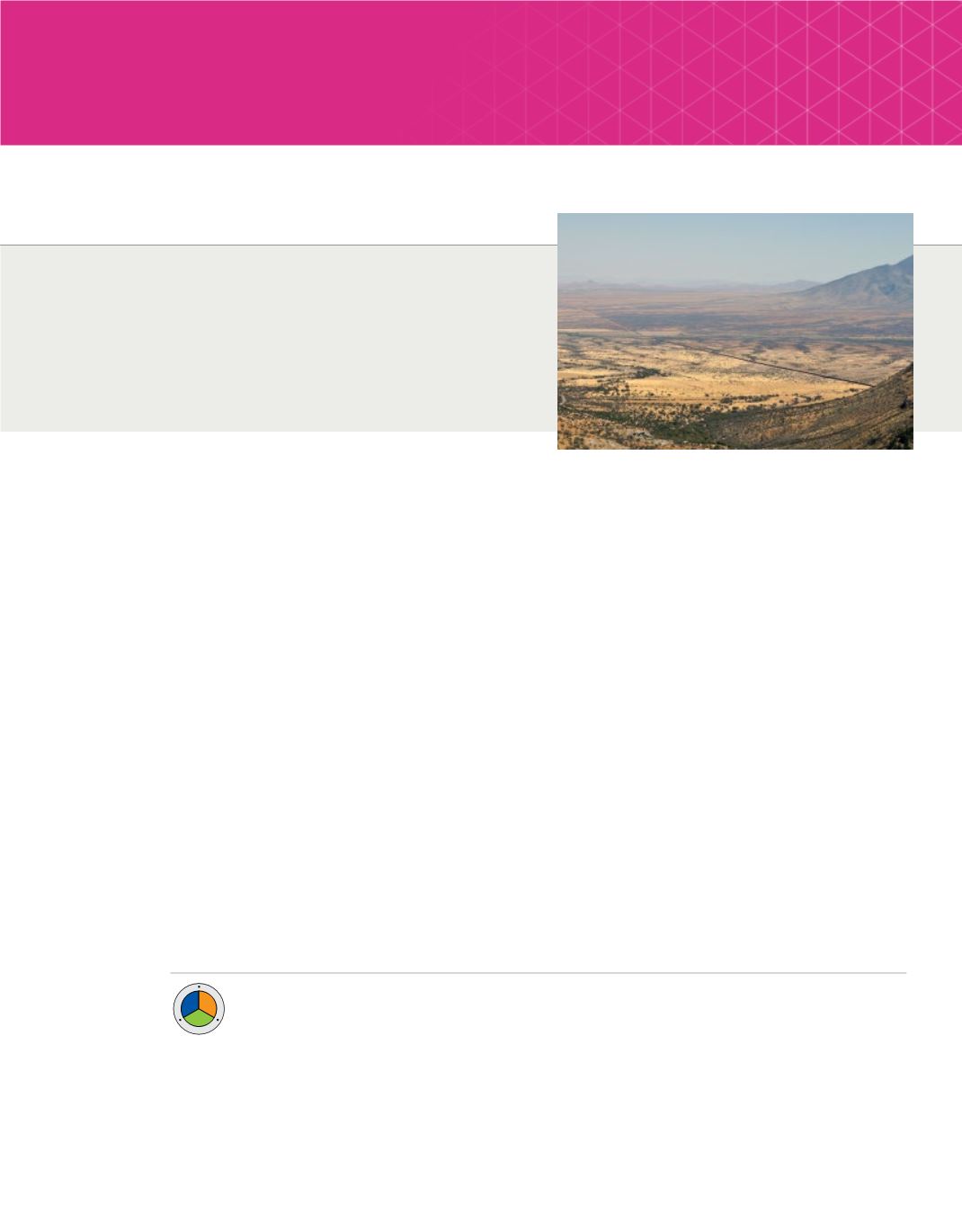
Norma Jean Gargasz/Alamy Stock Photo
COMMUNICATE SCIENTIFIC AND
TECHNICAL INFORMATION
Read a scientific study that used a computer
model to describe or predict an environmental
event or outcome related to climate change.
Summarize the study into a brief article to
share with your class.
C
C
C
S
E
P
D
C
I
STEM AT WORK
How Can Computer Models Predict an
Ecosystem’s Future?
The hydrology of the San Pedro Basin is critical to the
humans and wildlife that live in the area. Ecologists have
developed a computer model to help predict how climate
change will impact the availability of water in the region.
Studying the impact of changes in a
complex ecosystem can be difficult,
especially if you want to predict the effect
a change might have before it occurs.
Like other scientists, ecologists build and
interpret computer models to study changes
in complex systems.
Scientists Use Models
Scientists develop computer models by using
mathematical equations called algorithms,
which use patterns to predict future events.
Ecological modelers use data collected from
real ecosystems to build computer models
that can accurately describe past events.
When scientists test the model to find out if
it describes known or past events accurately,
they are validating the model. Validation
ensures that the researchers can trust the
predictions and descriptions generated when
unknown or hypothetical scenarios are run
through the model.
In climate change research, many scientists are
building and using computer models to try to
describe how the climate has changed, predict
how it will change, and forecast how different
interventions would help to curb the rate of
change. Information from larger scale models
can be used to build smaller scale models of
specific regions and ecosystems.
For example, some researchers assessed the
impact of climate change on water resources
of the San Pedro Basin, shown in the figure
above, an arid region in southeastern Arizona
and northern Sonora, Mexico. By using clearly
defined parameters regarding the ecosystem
they wanted to study and combining data from
multiple climate change models, they built
a three-dimensional transient groundwater-
surface water flow model. Then, they used the
model to simulate the hydrology of the region
from 2000 to 2100. The results of the study
were published in a peer reviewed journal
and will be used to inform future decisions
impacting the region’s water supply.
Module 2 • STEM at Work
45