What Makes You Say That?
Your students see hundreds of images daily. But are they looking? One simple question changes everything about how they engage with art, and critical thinking.
- Higher Education
- Article
- Blog
- In The Studio

Your Students Look at Images All Day. Are They Actually Seeing Them?
Put an unfamiliar artwork on the screen in an Art Appreciation class and ask, “What do you think?” Students either have fast answers…or it’s crickets.
Fast answers may come before you have finished asking the question.
This person is powerful.
That photograph is sad.
This is beautiful.
That is definitely not art.
And when you get crickets? Usually, students are still thinking. They may not be sure yet how to express their impressions.
I love all these first reactions. They give us somewhere to start. But then I ask the question that usually makes the conversation much more interesting:
What do you see that makes you say that?
Suddenly, having an opinion is not quite enough. Students have to go back to the image and figure out where that opinion came from.
Three Questions, One Image
One image that works particularly well for this is the Benin plaque in Chapter 1 of Living with Art. Show the image without its caption or any information about the work and start with one question:
Question 1: What do you think is happening here?
Give students about 30 seconds and have them write down their first response. They might identify the central figure as a ruler or leader. They may see the surrounding figures as guards or attendants. They may make immediate connections to power, status, ceremony, or conflict.
Do not correct anything yet. You want those first impressions.
Question 2: What are three things you can actually see?
This is where it gets interesting.
Not what something means. Not what students think it symbolizes. Three specific things they can point to in the image.
The central figure is larger than the others. Figures stand on either side of him. He holds objects in his hands. His clothing and adornment are elaborate. The composition is nearly symmetrical.
Students may have already decided what they think is happening. Now they have to figure out what made them reach that conclusion.
Question 3: Go back to your first answer. Does what you see now support what you thought then?
Ask students to use at least two of their three observations to revise their original response. They may strengthen that first interpretation. They may make it more specific. They may realize they made an assumption the image cannot actually support.
Any of these outcomes is useful.
You’re not looking for the “right” answer here. In fact, students do not know enough about the work yet to have one. You want them to notice the moment when observation becomes interpretation.
Then reveal the caption, introduce the work and its context, and ask one more question:
What would you change now?
Ten Minutes Is Plenty
This does not need to become a major assignment. Ten minutes at the beginning of class is enough.
Students can write individually and then compare responses with a partner, or you can collect their observations on the board before discussing them together. The important part is preserving that first response long enough for students to return to it.
Online, I use essentially the same approach. I post the image without identifying information and have students record their first response and three observations before revealing the caption and context. Then I ask them to return to that first response and revise it.
The point is not to make students afraid of getting something wrong. I want the opposite. I want students to make a claim. See if the evidence supports it. Change their minds when it does not.
This is good practice in an art class. It is pretty good practice everywhere else, too.
Same Activity, Different Conversation
The image you choose changes where the conversation goes.
With Lewis Hine’s One of the Spinners, students may begin constructing a story about the young girl almost immediately. What does the photograph actually tell us about her? What have we added ourselves?
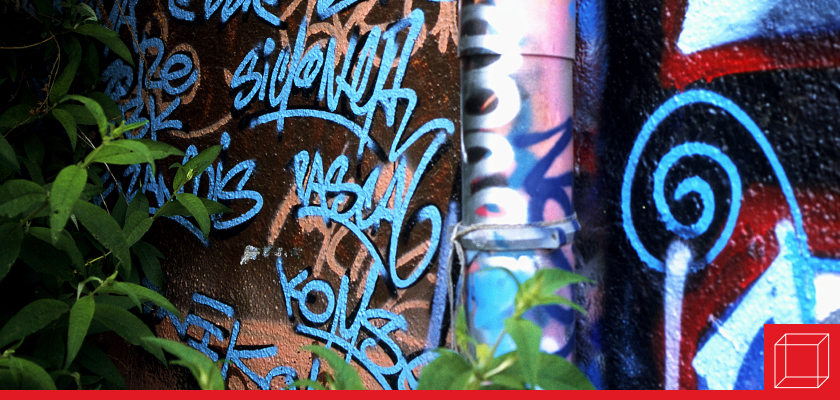
Try an image of the Wynwood Walls in Miami and something different happens. Students may quickly reach for words like art, graffiti, beautiful, chaotic, or vandalism. Great. Pick one.
What do you see that makes you say that?
The activity stays the same. The conversation changes.
Giving Students the Words for What They Already See
This activity creates a natural bridge between the opening chapter of Living with Art and the visual elements and principles of design in Chapters 4 and 5.
Students do not need to know all of that vocabulary before they begin looking. I actually like letting them discover that they needmore specific vocabulary to express their thoughts…and their art appreciation course supplies the language.
Students already notice that one figure is bigger. Later, we can give them scale. They notice that their attention keeps returning to one place. We can talk about emphasis. They notice repetition, balance, color, line, texture, and movement before they necessarily know what to call any of them.
The vocabulary gives them more precise ways to explain something they are already beginning to understand: what they see affects what they think.
And in a world where students encounter hundreds of images every day, there is value in asking them to spend a few extra minutes with one.
Not because we need them to agree about what it means.
Because we want them to be able to explain why they think what they think.
Keep the Conversation Going
- What did you assume about the image before you began describing it?
- Which visual detail most strongly supports your interpretation?
- Did anything you observed make your original interpretation harder to defend?
- What new information would make you change your mind?
Explore these ideas in the 2027 release of Living with Art. Preorder your sample.

Sheila Levi-Aland has taught Art & Humanities classes for over 20 years, both in person and online. She received her MA & MFA from the Savannah College of Art and Design with concentrations in 19th-century American art & a creative focus in Chinese painting. Her teaching style entails an interactive, hands-on approach to learning about the various periods covered in her courses. Students work with a variety of mediums to explore each genre and present projects that showcase creativity as well as engaged learning. Her goal is to have each student explore and find their passion! You can find her artwork in SCAD's presidential collection, and several private collections, along with her current publications in SECAC.