



 70 / 121

Sue Cunningham/Worldwide Picture Library/Alamy Stock Photo
CONSTRUCT AN ARGUMENT FROM
EVIDENCE
Brainstorm ideas about how people can stop
deforestation in the Amazon rainforest. Write
several paragraphs summarizing your ideas,
using evidence from the feature to explain
why stopping deforestation is necessary.
C
C
C
S
E
P
D
C
I
Out on a Limb
Threats to the Rainforest
For decades human activities have caused
large-scale deforestation in the Amazon.
These activities include logging, pollution,
forest fires, building roads, and clearing land
for farms and cattle ranches. Droughts also
contribute to deforestation.
Some scientists estimate that as much as
57 percent of the Amazon’s tree species
might be classified as threatened by 2050.
Of the five tree species that store the most
carbon in the Amazon, two are listed as
vulnerable by the International Union for
Conservation of Nature, including the Brazil
nut tree.
Consequences of Deforestation
If these predictions are correct, large portions
of the Amazon rainforest may soon cease
to exist. When trees die, they have a double
effect on levels of atmospheric carbon
dioxide: they release carbon dioxide into the
atmosphere as they decay and they no longer
remove carbon dioxide from the atmosphere
during photosynthesis.
The vast Amazon rainforest covers about
7.8 million km
2
of land in South America,
spanning the borders of Brazil, Peru, Bolivia,
Venezuela, and Columbia. Trees that grow in
the Amazon remove enormous amounts of
carbon dioxide from the atmosphere during
photosynthesis. Rainforests store this carbon,
helping to slow climate change. Of all the
carbon on Earth stored by terrestrial plants,
17 percent is found in the Amazon rainforest.
Half of that carbon is concentrated in just 150
species of the Amazon’s estimated 16,000
species of trees. That’s a mere one percent
of the tree species in the rainforest. What
happens to Earth’s climate when these key
tree species are destroyed?
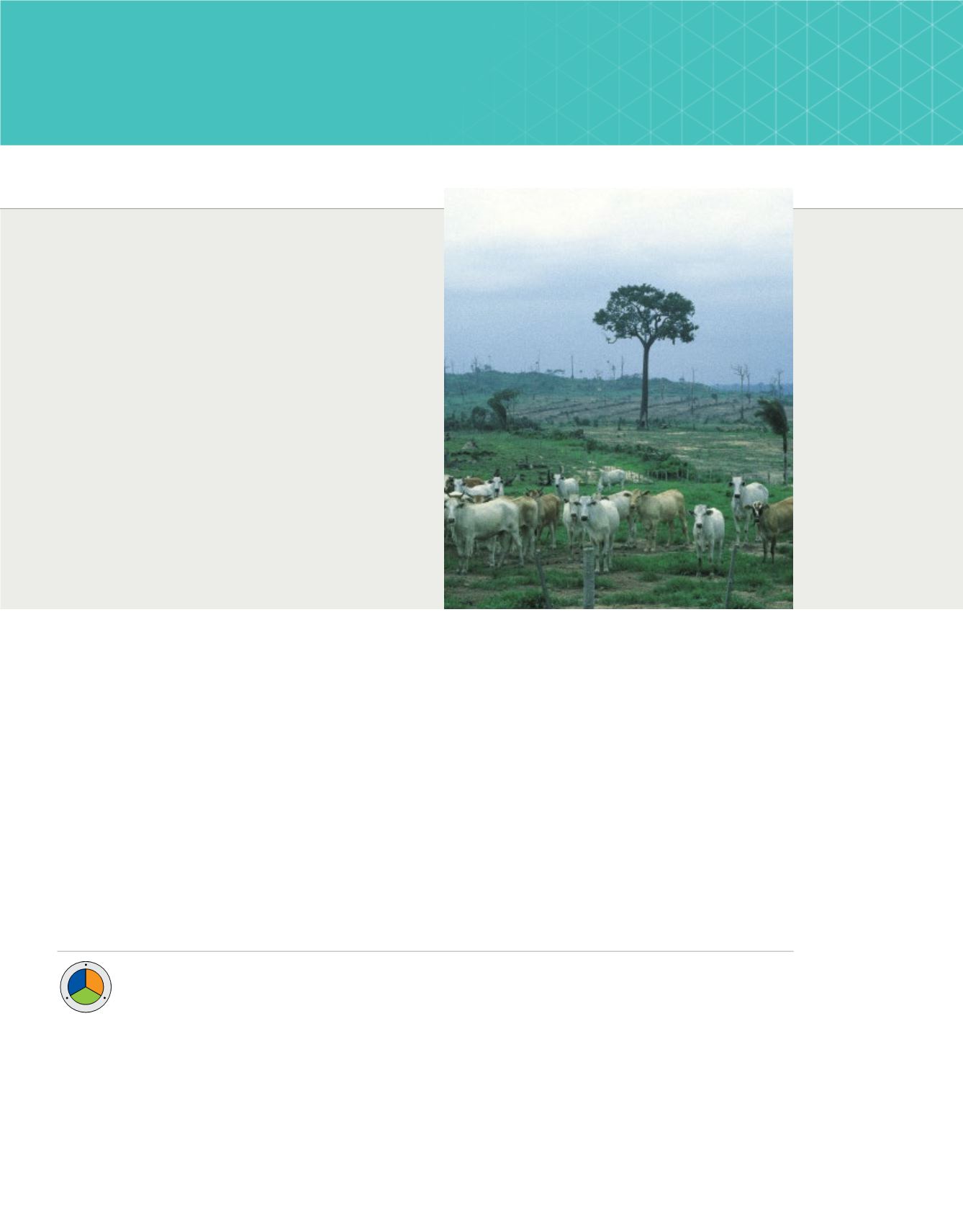
Cattle ranching is one of the causes of deforestation.
SCIENCE & SOCIETY
72
Module 3 • Science & Society