


 68 / 121

(l) Richard Carey/iStockphoto/Getty Images; (r) r.classen/Shutterstock.com
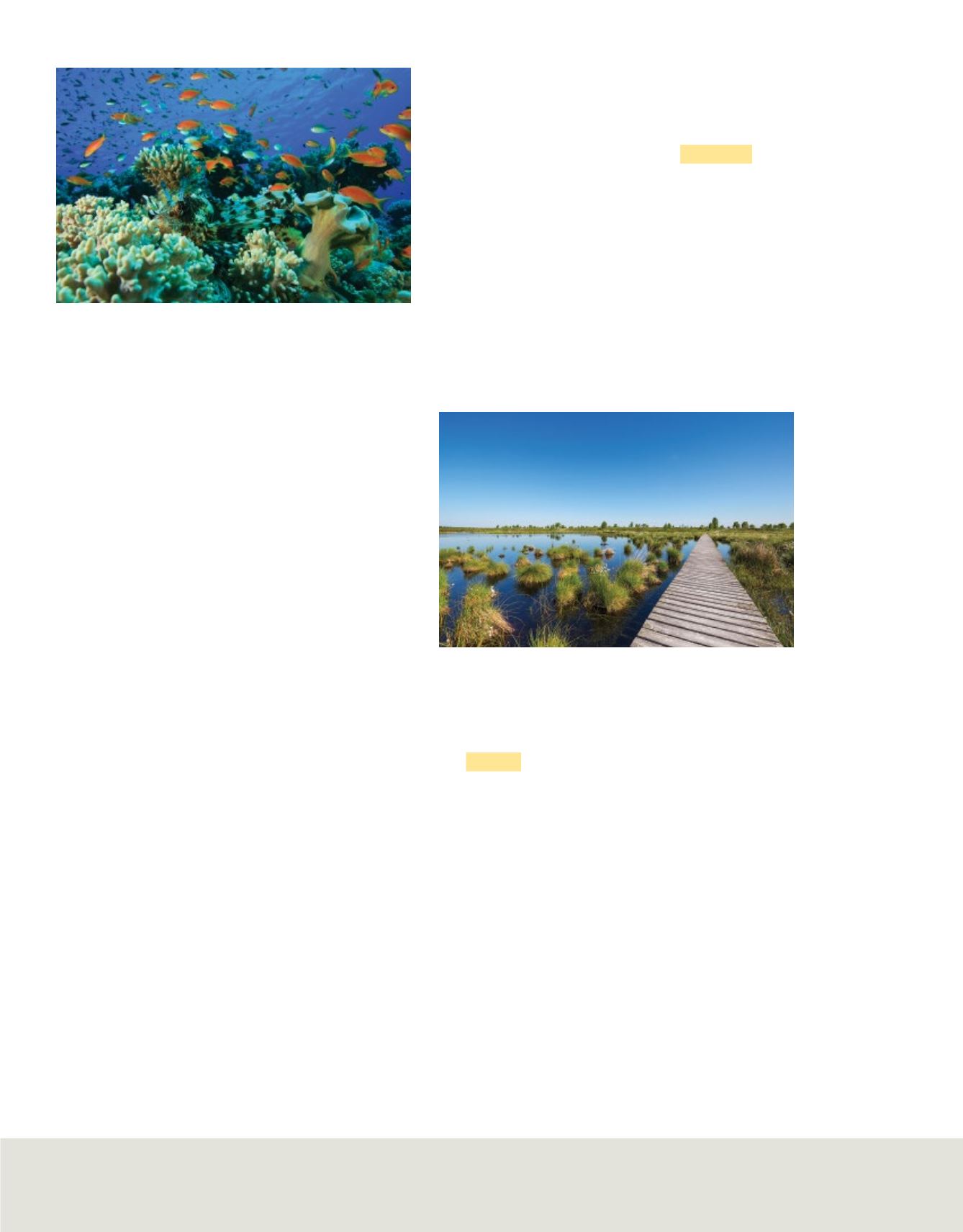
Figure 25
shows only a small portion of the
diversity of Florida’s coral reefs.
Like all ecosystems, coral reefs are sensitive to
changes in the environment. Changes that are
the result of naturally occurring events, such as
increased sediment from a tsunami, can cause
the death of a reef.
Human activities, such as land development and
harvesting for calcium carbonate, can also damage
or kill a coral reef. The increase in atmospheric
carbon dioxide (CO
2
) indirectly affects coral reefs.
As seawater absorbs more CO
2
the pH of the
water decreases, making the water more acidic.
This can reduce the availability of the calcium
carbonate minerals which coral polyps use to build
their hard protective structure. Today, ecologists
monitor reefs and reef environments to help
protect these delicate ecosystems.
Transitional Aquatic
Ecosystems
In many areas, aquatic ecosystems do not look
like a stream, a lake, a pond, or even an ocean.
In fact, many aquatic environments are a combi-
nation of two or more different environments.
Ecologists refer to these areas as transitional
aquatic ecosystems, areas where land and water
or salt water and freshwater intermingle.
Wetlands and estuaries are common examples
of transitional aquatic ecosystems.
Wetlands
Areas of land such as marshes, swamps, and
bogs that are saturated with water and that
support aquatic plants are called
wetlands.
Plant species that grow in the moist, humid
conditions of wetlands include duckweed, pond
lilies, cattails, sedges, mangroves, cypress, and
willows. Bogs, like the one in
Figure 26,
are wet
and spongy areas of decomposing vegetation
that also support many species of organisms.
Wetlands have high levels of species diversity.
Many amphibians, reptiles, birds (such as ducks
and herons), and mammals (such as raccoons
and mink) live in wetlands.
Estuaries
An
estuary
(ES chuh wer ee) is an ecosystem
that is formed where freshwater from a river or
stream merges with salt water from the ocean.
An estuary is a very important transitional
ecosystem.
Estuaries are among the most diverse ecosys-
tems, rivaled only by tropical rain forests and
coral reefs. Estuaries are places of transition,
from freshwater to saltwater and from land to
sea, that are inhabited by a wide variety of
species. Algae, seaweeds, and marsh grasses are
the dominant producers. However, many
animals, including a variety of worms, oysters,
and crabs, depend on detritus for food. Detritus
(dih TRY tus) is comprised of tiny pieces of
organic material.
Figure 25
Coral reefs off the southern tip of Florida are
among the world’s largest and most diverse reefs.
Figure 26
Bogs are a type of wetland characterized by
moist, decaying plant material.
70
Module 3 • Communities, Biomes, and Ecosystems