


 69 / 121

McGraw-Hill Education
Go online to follow your personalized learning path to review, practice,
and reinforce your understanding.
Check Your Progress
Summary
• Freshwater ecosystems include
ponds, lakes, streams, rivers,
and wetlands.
• Marine ecosystems are divided
into zones that are classified
according to abiotic factors.
• Estuaries and coral reefs are
among the most diverse of all
ecosystems.
• Wetlands and estuaries are
transitional aquatic
ecosystems.
Demonstrate Understanding
1.
List
the abiotic factors that are used to classify aquatic
ecosystems.
2.
Describe
how water quality changes from the source
of a river to the mouth.
3.
Explain
how the salinity (salt concentration) of an
estuary affects the kinds of organisms that live there.
Explain Your Thinking
4.
Infer
how autotrophs in the abyssal zone of the ocean
are different from those of the photic zone.
5.
Explain
how light, depth, and temperature affect the
number and type of organisms that live in each ocean
zone.
6.
Describe
, based on the information in this lesson and
your acquired knowledge, some ways that human
activities are affecting aquatic ecosystems. Propose
strategies that individuals can use and governments
can implement that would prevent or reduce these
human impacts.
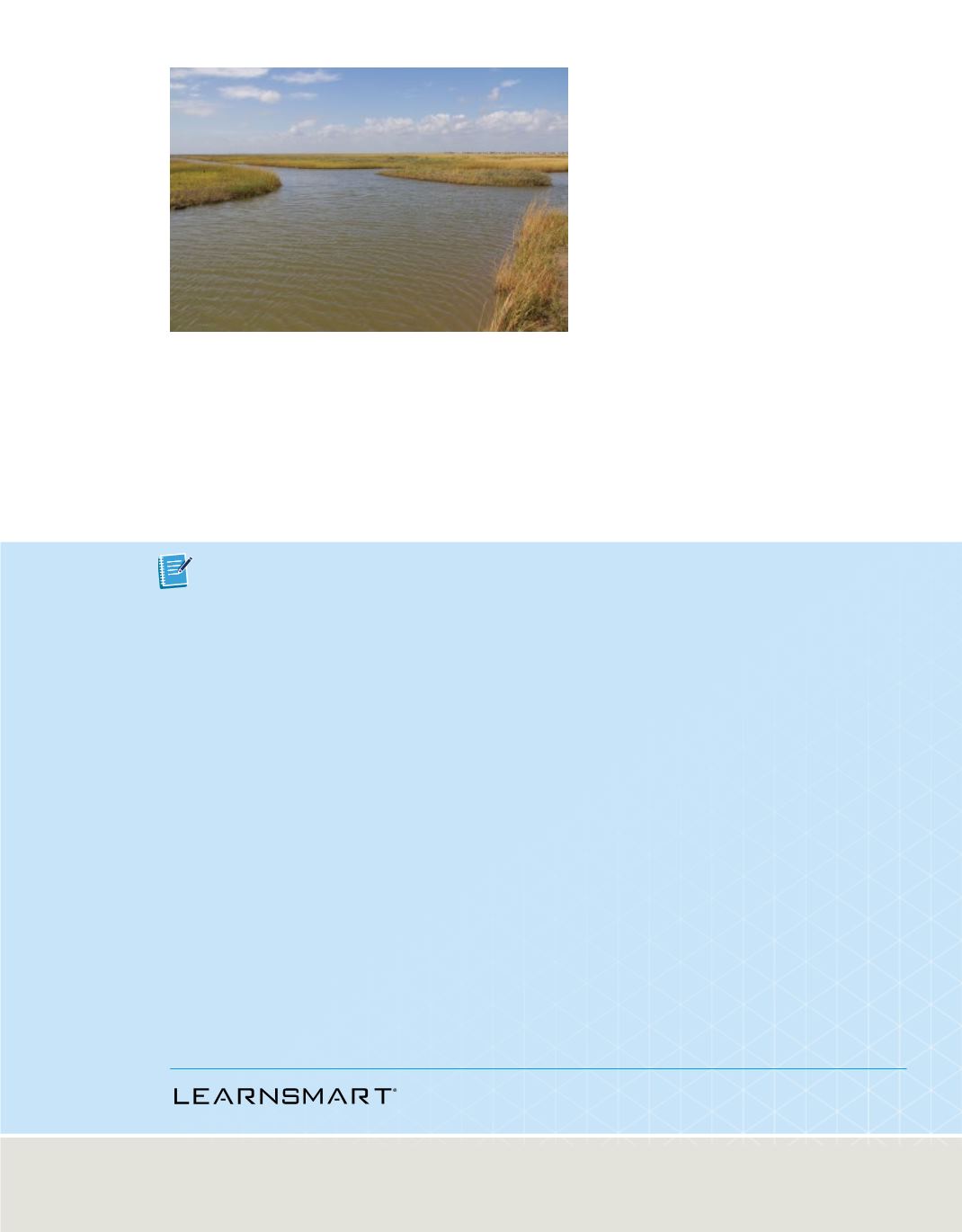
Figure 27
Salt-tolerant plants above
the low-tide line dominate estuaries
formed in temperate areas.
Infer
how an estuary would differ in a
tropical area.
Mangrove trees also can be found in tropical estuaries, such as the Everglades National
Park in Florida, where they sometimes form swamps. Many species of marine fishes
and invertebrates use estuaries as nurseries for their young. Ducks and other waterfowl
depend on estuary ecosystems for nesting, feeding, and migration rest areas.
Figure 27
shows the salt-tolerant plants that live in an estuary.
Salt marshes are a habitat type found within estuaries. Salt-tolerant grasses dominate
above the low-tide line, and seagrasses grow in submerged areas of salt marshes. Salt
marshes support different species of animals, such as shrimp and shellfish.
Lesson 3 • Aquatic Ecosystems
71