


 25 / 121

(t) NASA GSFC image by Robert Simmon and Reto Stöckli; (cl) ©H Lansdown/Alamy; (cr) NOAA PMEL Vents Program;
(b) Ken Canning/E+/Getty Images
The Biosphere
Because ecologists study organisms and their
environments, their studies take place in the
biosphere. The
biosphere
(BI uh sfihr) is the
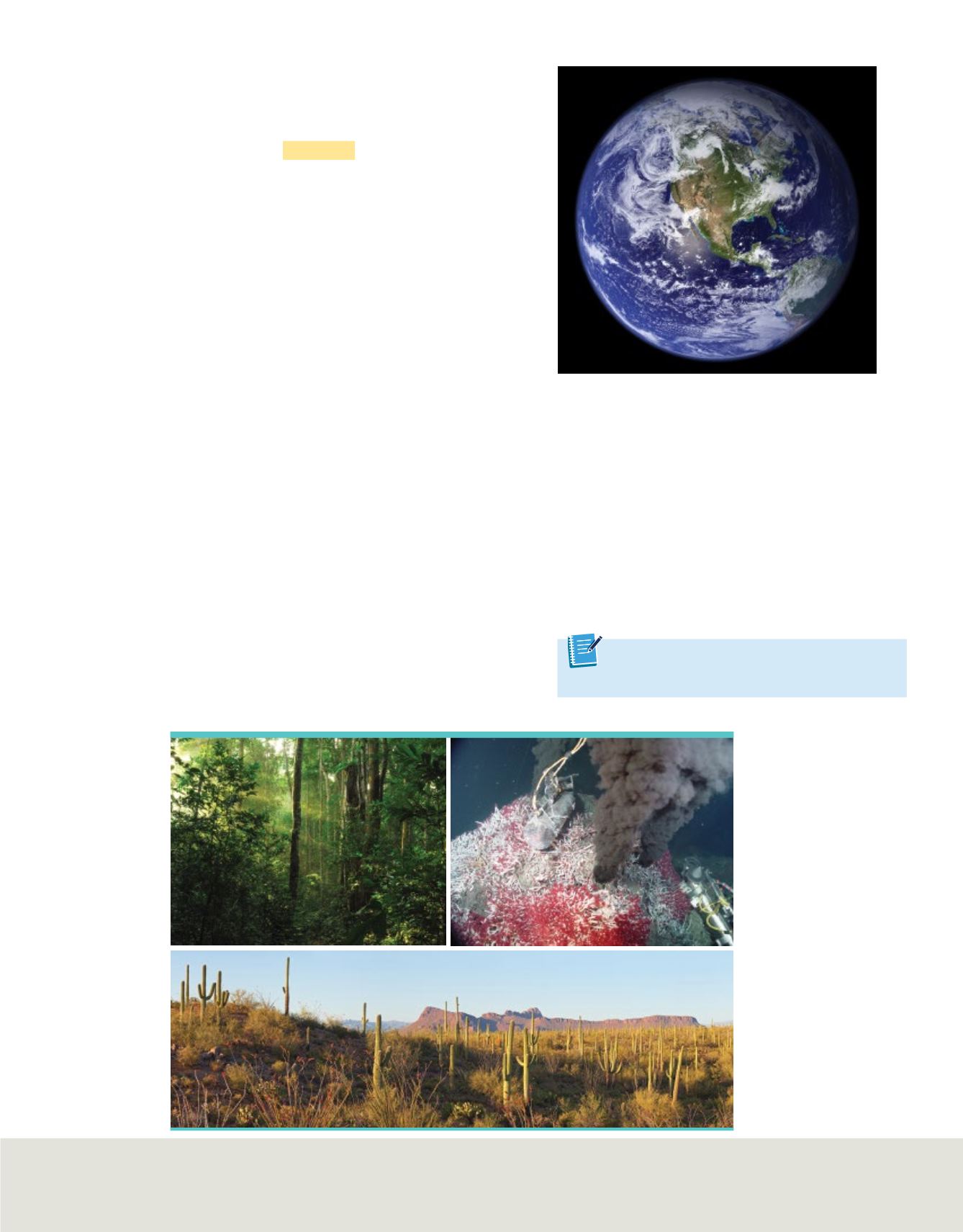
portion of Earth that supports life. The photo of
Earth taken from space shown in
Figure 3
shows why the meaning of the term
biosphere
should be easy to remember. The term
bio
means “life,” and a sphere is a geometric shape
that looks like a ball. When you look at Earth
from this vantage point, you can see how it is
considered to be “a ball of life.”
Although “ball of life” is the literal meaning of
the word
biosphere
, this is somewhat mislead-
ing. The biosphere includes only the portion of
Earth that includes life. The biosphere forms a
thin layer around Earth. It extends several
kilometers above Earth’s surface into the
atmosphere and extends several kilometers
below the ocean’s surface to the deep-ocean
vents. It includes landmasses, bodies of fresh-
water and saltwater, and all locations below
Earth’s surface that support life.
Figure 4
shows a glimpse into the vast amount
of diversity contained within Earth’s biosphere.
From rainforests to deserts to deep-ocean vents,
diverse organisms populate diverse locations.
The biosphere’s diverse locations contain
organisms that are able to survive in the unique
conditions found in their particular environ-
ment. Ecologists study these organisms, their
adaptations, and the factors in their environ-
ment. These factors are divided into two large
groups—the living factors and the nonliving
factors.
Figure 3
This color-enhanced satellite photo of Earth
taken from space shows a large portion of the biosphere.
Get It?
Define
the term
biosphere
.
Figure 4
Rainforests,
deserts, and deep-ocean
vents are all home to
unique organisms. The
plants, animals, and
microorganisms that live in
each of these parts of the
biosphere are adapted to
the living and nonliving
factors there.
Lesson 1 • Organisms and Their Relationships
27