


 26 / 121

Lightwriter1949/iStock/Getty Images
Biotic factors
The living factors in an organism’s environment
are called the
biotic
(by AH tihk)
factors.
Consider the biotic factors in the stream com-
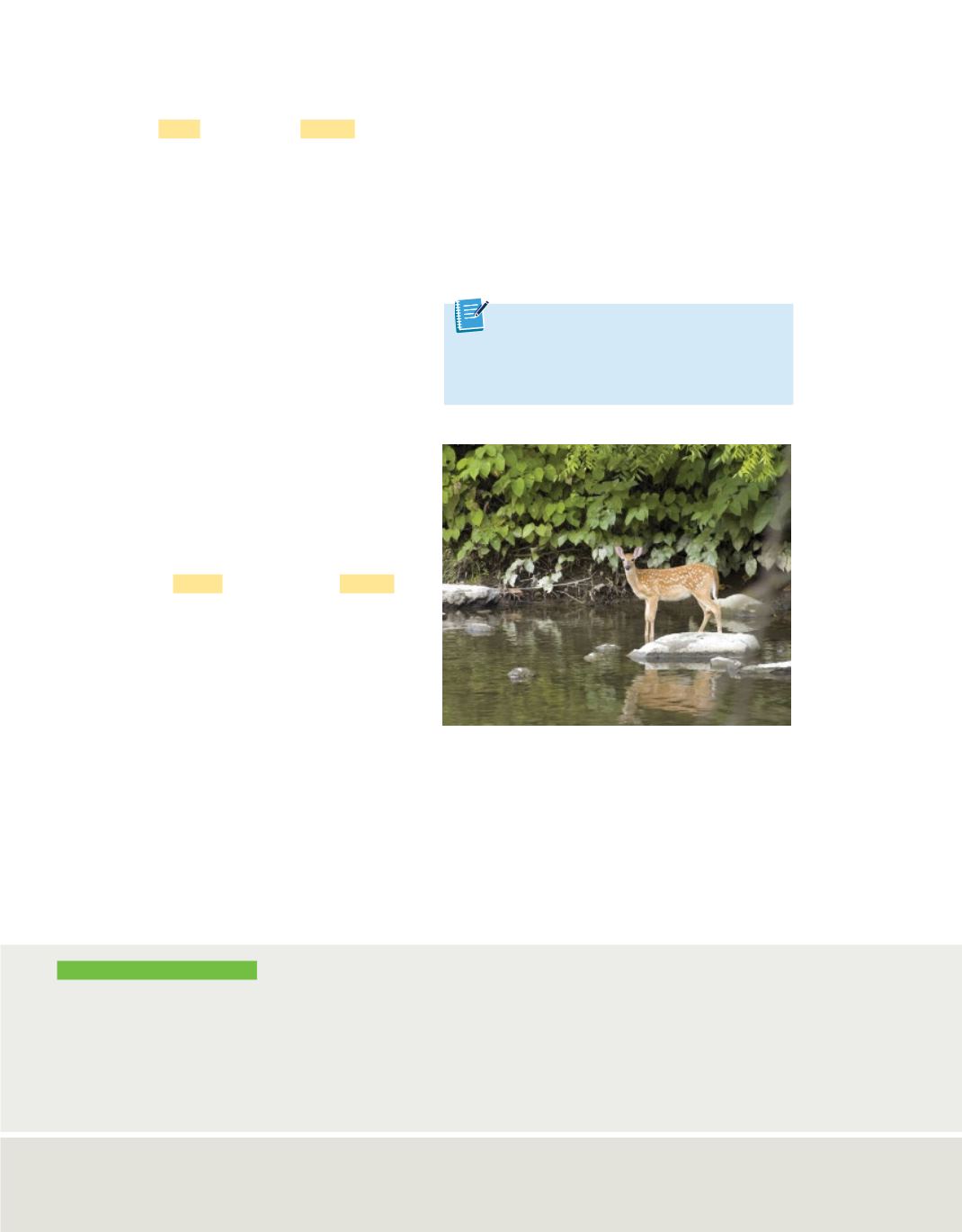
munity shown in
Figure 5.
These biotic factors
include all of the organisms that live in the
water, such as fish, algae, frogs, and micro-
scopic organisms. In addition, organisms that
live on the land adjacent to the water are biotic
factors for the deer. Additionally, migratory
animals, such as birds that pass through the
area, are biotic factors.
The interactions among organisms are neces-
sary for the health of all species in the same
geographic location. For example, the deer
need other members of its species to reproduce.
Deer also depend on other organisms for food
and, in turn, are a food source for other
organisms.
Abiotic factors
The nonliving factors in an organism’s environ-
ment are called
abiotic
(ay bi AH tihk)
factors.
The abiotic factors for different organisms vary
across the biosphere, but organisms that live in
the same geographic area might share the same
abiotic factors. These factors might include
temperature, air or water currents, sunlight,
soil type, rainfall, or available nutrients.
Organisms depend on abiotic factors for
survival. For example, the abiotic factors
important to a particular plant might be the
amount of rainfall, the amount of sunlight, the
type of soil, the range of temperature, and the
nutrients available in the soil. The abiotic
factors for the deer in
Figure 5
include the air
temperature, the minerals present in the rocks,
and the hours of sunlight per day.
Organisms are adapted to surviving in the
abiotic factors that are present in their natural
environments. If an organism moves to another
location with a different set of abiotic factors,
the organism might die if it cannot adjust
quickly to its new surroundings. For example, if
a lush green plant that normally grows in a
swampy area is transplanted to a dry desert, the
plant likely will die because it cannot adjust to
abiotic factors present in the desert.
Figure 5
The deer standing on this rock is a biotic factor
in this stream community. Other organisms in the water,
such as frogs and algae, also are biotic factors.
Explain
how organisms are dependent on other
organisms.
STEM CAREER Connection
Conservation Scientist
Do you care about preserving and protecting national and state parks and other
natural areas? Conservation scientists are responsible for managing the overall
land quality of forests, parks, rangelands, and other natural resources. They
oversee foresting and conservation activities on public park lands, and they also
may work with private land owners or organizations.
Get It?
Compare and contrast
abiotic and biotic
factors shown in the photo at the beginning
of this module.
28
Module 2 • Principles of Ecology