


 104 / 121

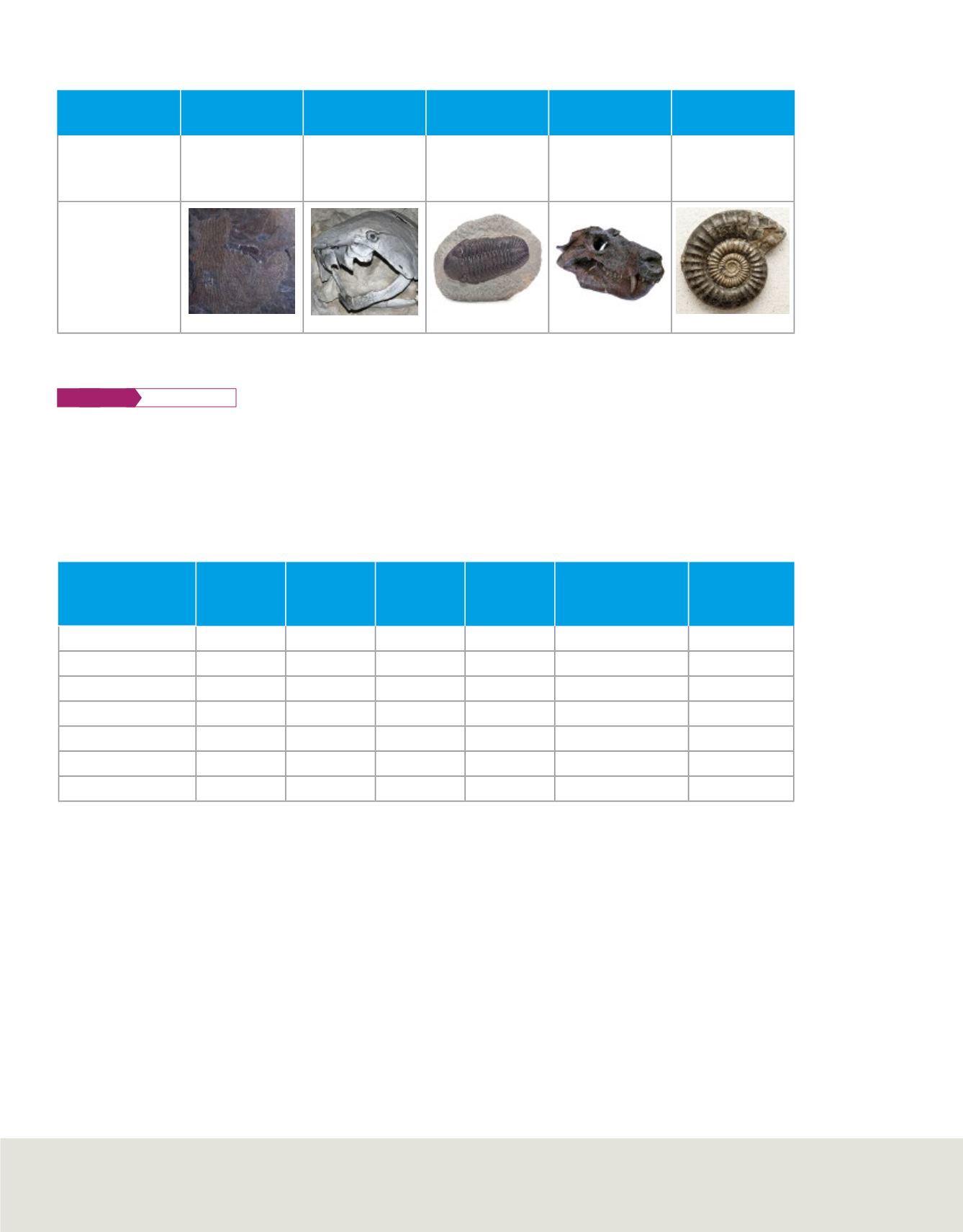
(l to r) De Agostini Picture Library/Getty Images; Sabena Jane Blackbird/Alamy; farbled/Shutterstock.com; The Natural History Museum/Alamy;
Blackbeck/iStock/Getty Images
Table 1
Five Most Recent Mass Extinctions
Ordovician
Period
Devonian
Period
Permian
Period
Triassic
Period
Cretaceous
Period
Time
about 444
million years
ago
about 360
million years
ago
about 251
million years
ago
about 200
million years
ago
about 65
million years
ago
Example
Graptolites
Dinichthys
Trilobite
Cynognathus
Ammonite
The accelerated loss of species began several centuries
ago.
Table 2
shows the estimated number of extinctions that have occurred by group
since 1600. Many of the species’ extinctions in the past have occurred on islands. For
example, 60 percent of the mammals that have become extinct in the past 500 years
lived on islands, and 81 percent of bird extinctions occurred on islands.
Table 2
Estimated Number of Extinctions Since 1600
Group
Mainland Island Ocean Total
Approximate
Number of
Known Species
Percent of
Group
Extinct
Mammals
30
51
4
85
4000
2.1
Birds
21
92
0
113
9000
1.3
Reptiles
1
20
0
21
6300
0.3
Amphibians*
2
0
0
2
4200
0.05
Fish
22
1
0
23
19,100
0.1
Invertebrates
49
48
1
98
1,000,000+
0.01
Flowering Plants
245
139
0
384
250,000
0.2
*An alarming decrease of amphibian populations has occurred since the mid-1970s, and many species might be
on the verge of extinction.
Species on islands are particularly vulnerable to extinction because of several factors.
Many of these species evolved without the presence of natural predators. As a result,
when a predator, such as a dog, cat, rat, or human, is introduced to the population, the
native animals do not have the ability or skills to escape. When a nonnative species is
introduced to a new population, it can be a carrier of a disease to which the native
population has no resistance. The native population often dies off as a result. In addition,
islands typically have relatively small population sizes and individual animals rarely travel
between islands, both of which increases the vulnerability of island species to extinction.
Connection
HISTORY
106
Module 5 • Biodiversity and Conservation