



 56 / 121

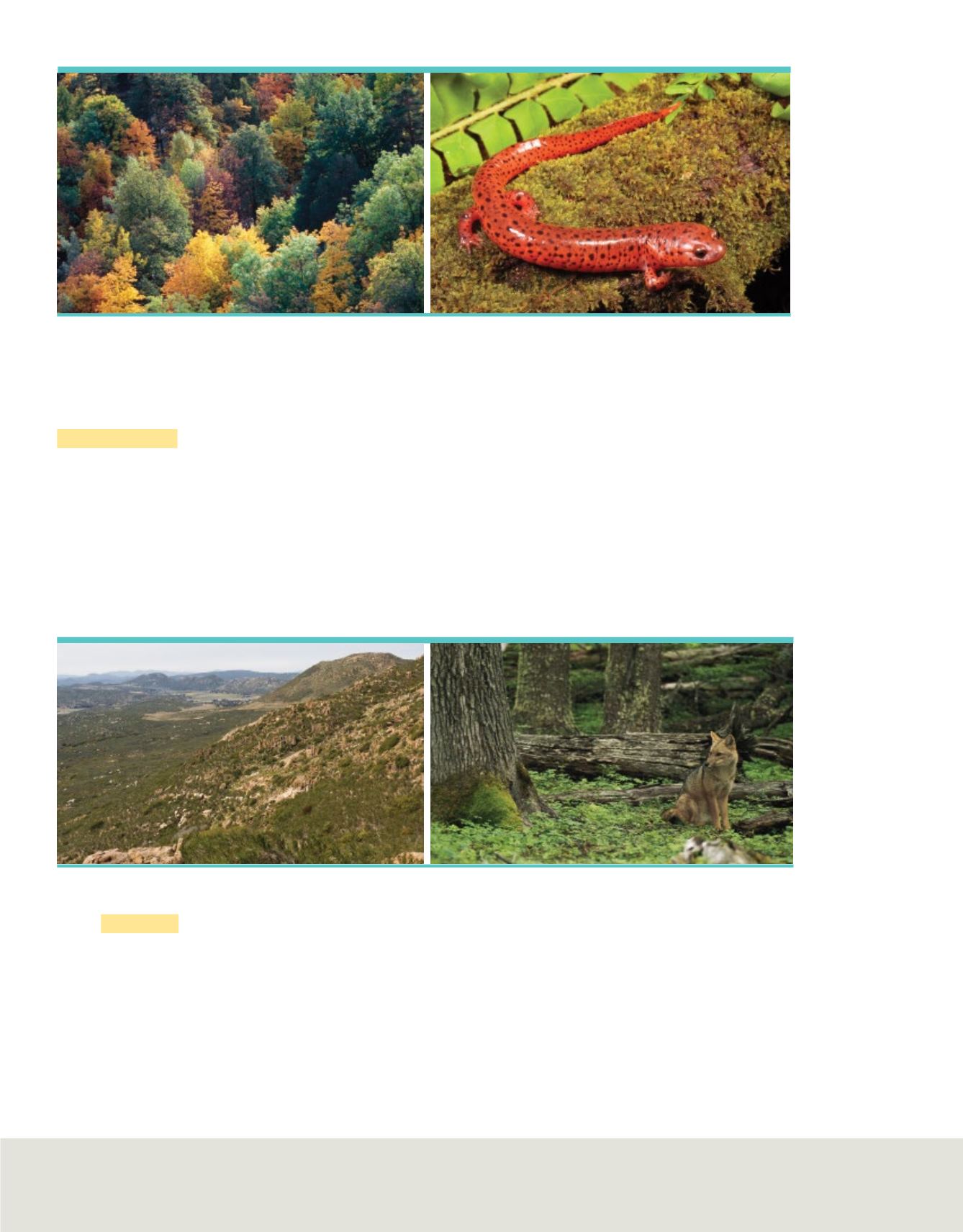
(tl)C. Sappa/De Agostini Picture Library/Getty Images; (tr)George Grall/National Geographic RF/Getty Images; (bl)Patrick Poendl/Shutterstock.com; (br)Bill Hatcher/National Geographic/Getty Images
Temperate forest
Temperate forests cover much of southeastern
Canada, the eastern United States, most of
Europe, and parts of Asia and Australia. The
temperate forest
is composed mostly of broad-
leaved, deciduous (dih SIH juh wus) trees—trees
that shed their leaves in autumn. The falling
leaves return nutrients to the soil. All four
seasons occur in temperate forests. In spring,
warm temperatures and precipitation restart the
growth cycles of plants and trees. Warmer
temperatures also enable amphibians like the red
salamander shown in
Figure 9
to survive.
Figure 9
Temperate forest
Average precipitation:
75–150 cm per year
Temperature range:
–30˚C to 30˚C
Plant species:
oak, beech, and maple trees, shrubs
Animal species:
amphibians and reptiles, squirrels, rabbits,
skunks, birds, deer, foxes, black bears, frogs, snakes
Geographic location:
Australia, and south of the boreal
forest in North America, Europe and eastern Asia
Abiotic factors:
well-defined seasons; summers are hot, and
winters are cold
Temperate woodland and shrubland
Open
woodlands
and mixed shrub communities
are found in areas with less annual rainfall than in
temperate forests. The woodland biome occurs in
areas surrounding the Mediterranean Sea, on the
western coasts of North and South America, in South
Africa, and Australia. Areas that are dominated by
shrubs, such as in California, are called the chaparral.
Woodland animals like the fox in
Figure 10
must have adaptations that allow them to survive
in both hot, dry summers and cool, wet winters.
Figure 10
Temperate woodland and shrubland
Average precipitation:
38–100 cm per year
Temperature range:
10˚C to 40˚C
Plant species:
evergreen shrubs, cork oak
Animal species:
foxes, jackrabbits, bobcats, coyotes,
reptiles, butterflies
Geographic location:
surrounds the Mediterranean Sea,
western coasts of North and South America, South Africa,
and Australia
Abiotic factors:
hot, dry summers and cool, wet winters
58
Module 3 • Communities, Biomes, and Ecosystems