



 50 / 121

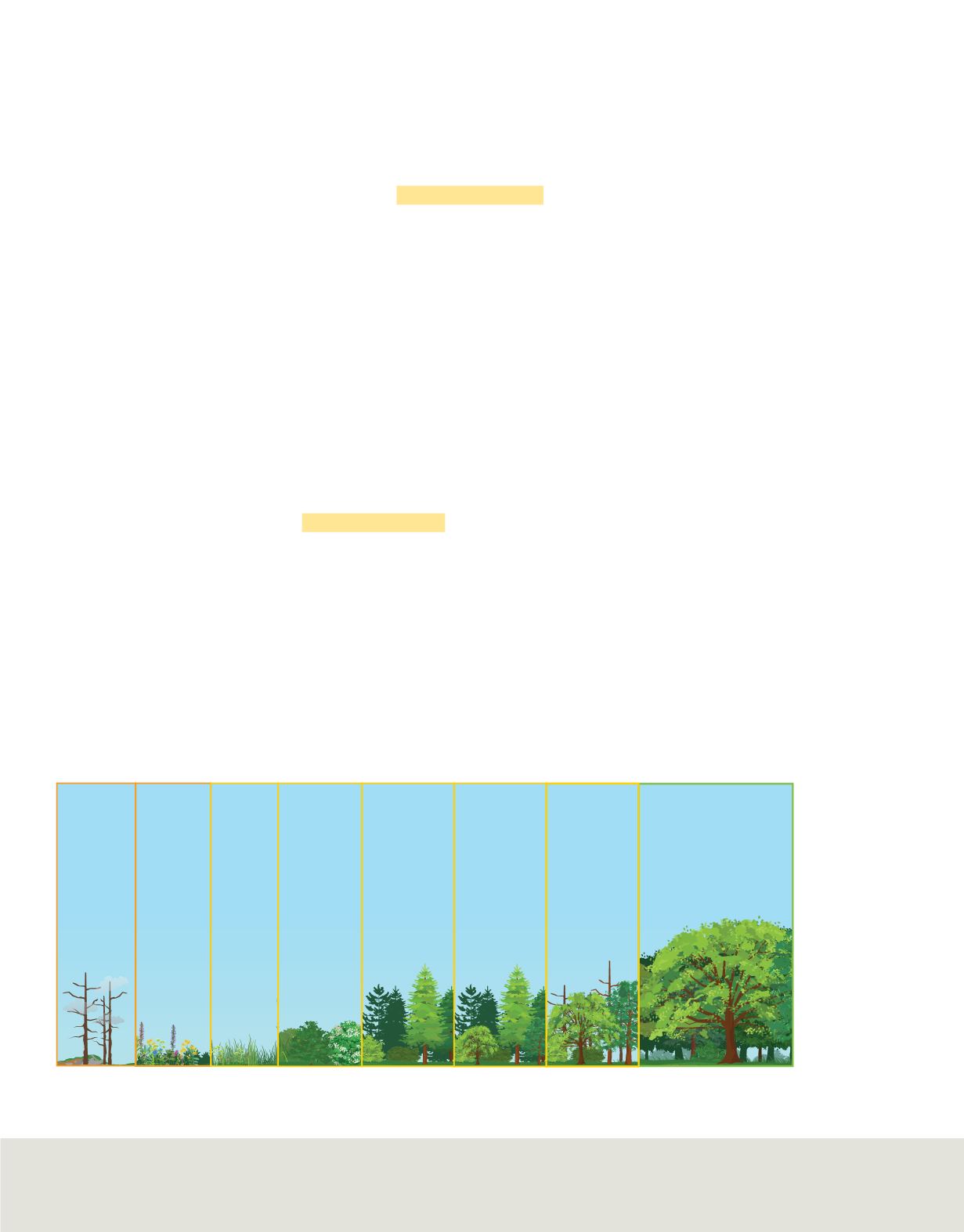
Disturbance
0
1-2 years 3-4 years 4-15 years
5-15 years
10-30 years
50-75 years
Pines die,
oak/hickory
mature
Mature
oak/hickory
forest
Young oak/
hickory
Pines
Shrubs
Grasses
and
herbs
Annual
plants
75+ years
Primary succession
On a solidified lava flow or exposed rocks on a cliff, no soil is present. If you took a
sample from such a site and looked at it under a microscope, the only biological organ-
isms you would observe would be bacteria and perhaps fungal spores or pollen grains
that drifted there on air currents. The establishment of a community in an area of
exposed rock that does not have any topsoil is
primary succession,
which is illustrated
in
Figure 2
on the last page. Primary succession usually occurs very slowly at first.
Almost all plants require soil for growth. But how is soil formed? Usually lichens, a
mutualistic combination of a fungus and algae, begin to grow on the rock. Because
lichens are among the first organisms to appear, they are called pioneer species. Pioneer
species help to create soil by producing acids that help to break down rocks. As pioneer
organisms die, their decaying organic materials, along with bits of sediment from the
rocks, make up the first stage of soil development. At this point, small plants, including
ferns, and other organisms such as fungi and insects, become established. As these
organisms die, additional soil is created. Seeds, transported by animals, water, or wind,
begin to grow in the newly formed soil. Eventually, enough soil is present so that shrubs
and trees can grow.
A mature community can eventually develop from bare rock, as shown in the last
page in
Figure 2.
The stable, mature community that results when there is little change
in the composition of species is a
climax community.
Scientists today realize that
disturbances, such as climate change, are ongoing; therefore, a true climax community
is unlikely to occur.
Secondary succession
Disturbances such as a fire, flood, or windstorm can disrupt a community. Human
activities also affect the species that might be present. If a modest biological or physical
disturbance to an ecosystem occurs, it may return to its more or less original state (i.e.,
the ecosystem is resilient), as opposed to becoming a very different ecosystem. Extreme
fluctuations in conditions or the size of any population, however, can challenge the
functioning of ecosystems in terms of resources and habitat availability. After a distur-
bance, new species of plants and animals might occupy the habitat.
Figure 3
After a fire, a forest might appear devastated. However, a series of changes ultimately leads back
to a mature community.
52
Module 3 • Communities, Biomes, and Ecosystems