



 49 / 121

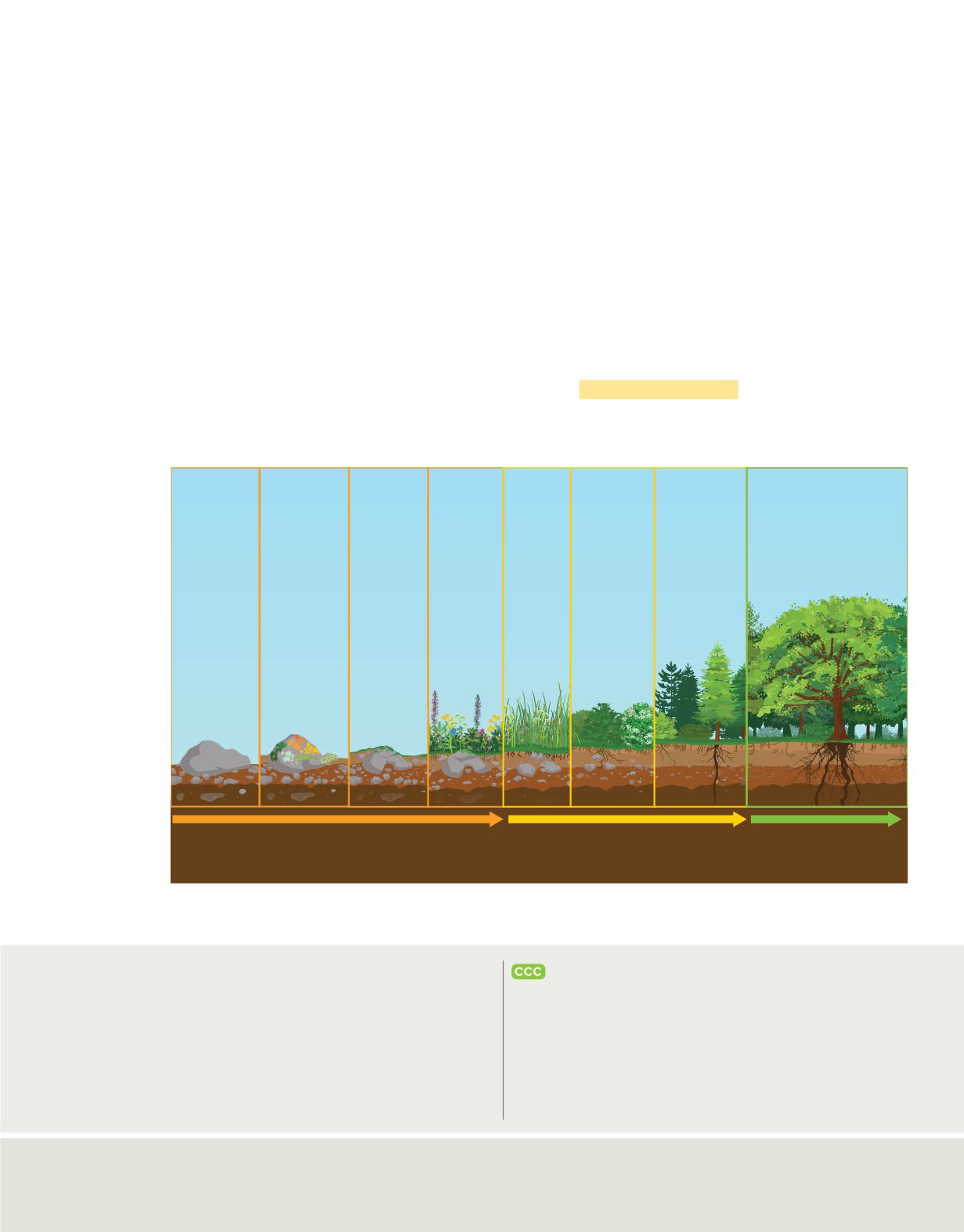
Pioneer stages
Intermediate stages
Mature community
Bare rock
Lichens
Mosses Herbs and
weeds
Grasses
Shade-tolerant trees
Shrubs Shade-intolerant
trees
Ecological Succession
A complex set of interactions within an ecosystem can keep its numbers and types of
organisms relatively constant over long periods of time under stable conditions.
However, ecosystems are constantly changing. They might be modified in small ways,
such as a tree falling in the forest, or in large ways, such as a forest fire. Such changes
might alter the communities that exist in the ecosystem. Forest fires can be good and
even necessary for the forest community. Forest fires return nutrients to the soil. Some
plants, such as fireweed, have seeds that will not sprout until they are heated by fire.
Some ecosystems depend on fires to get rid of debris. If fires are prevented, debris
builds up to the point where the next fire might burn the shrubs and trees completely.
A forest fire might change the habitat so drastically that some species can no longer
survive, but other species might thrive in the new, charred conditions.
The change that occurs in an ecosystem when one community replaces another as a
result of changing abiotic and biotic factors is known as
ecological succession.
There are
two types of succession—primary succession, shown in
Figure 2,
and secondary
succession, shown on the next page in
Figure 3
. Both result in a changed ecosystem.
Figure 2
The formation of soil is the first step in primary succession. Once soil formation starts, there is
progressive succession toward a climax community.
VOCABULARY:
SCIENCE USAGE v. COMMON USAGE
primary
Science usage:
first in rank, importance, value, or
order
A doctor’s primary concern should be the patient.
Common usage:
the early years of formal education
Elementary grades, up to high school, are considered
to comprise a student’s primary education
CROSSCUTTING CONCEPTS
Stability and Change
Over the weekend spend some time outside in
the local area around your school, home, or nearby park. Observe the
biotic and abiotic factors present in the area. Do you think succession
is taking place in the area? What evidence suggests that things are
changing? What evidence suggests that things haven’t changed for a
long time? Use your phone or other video camera to record the
evidence.
Lesson 1 • Community Ecology
51