* The estimated amount of time this product will be on the market is based on a number of factors, including faculty input to instructional design and the prior revision cycle and updates to academic research-which typically results in a revision cycle ranging from every two to four years for this product. Pricing subject to change at any time.

Instructor Quick Actions

Get eBook Access Get access as soon as you validate!
Request a Print Sample Get a copy as soon as validated.
Contact a Rep Find a local rep best suited for you.
Find Rep

Product Information

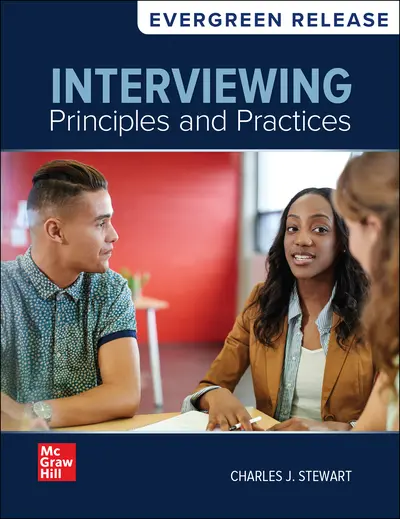
Interviewing: Principles and Practices, the most widely-used text for the interviewing course, continues to reflect the growing sophistication with which interviewing is being approached, incorporating the ever-expanding body of research in all types of interview settings, recent communication theory, and the importance of equal opportunity laws on interviewing practices. It provides the most thorough treatment of the basics of interviewing, including the complex interpersonal communication process, types and uses of questions, and the structuring of interviews from opening to closing.

McGraw Hill eBooks and digital platforms use an Evergreen delivery model with a release-centered process that makes it easy to keep courses fresh, engaging, and relevant.

Release Notes provide detailed information about new and updated content delivered with each release.

Your account requires validation. Please contact your sales representative.

1 An Introduction to Interviewing

2 An Interactional, Collaborative Communication Process

3 Questions and Their Uses

4 Structuring the Interview

5 The Informational Interview

6 The Survey Interview

7 The Recruiting Interview

8 The Employment Interview

9 The Performance Review Interview

10 The Persuasive Interview

11 The Counseling Interview

12 The Health Care Interview

About the Author

Charles J. Stewart

Charles J. Stewart is the former Margaret Church Distinguished Professor of Communication at Purdue University where he taught from 1961 to 2009. He taught undergraduate courses in interviewing and persuasion and graduate courses in such areas as persuasion and social movements, apologetic rhetoric, and extremist rhetoric on the Internet. He received the Charles B. Murphy Award for Outstanding Undergraduate Teaching from Purdue University and the Donald H. Ecroyd Award for outstanding Teaching in Higher Education from the National Communication Association. He has written articles, chapters, and books on interviewing, persuasion, and social movements. He has been a consultant with organizations such as the Internal Revenue Service, the American Electric Power Company, Libby Foods, the Indiana University School of Dentistry, and the United Association of Plumbers and Pipefitters. He is currently a Court Appointed Special Advocate for children (CASA).

Ways of reading

  • No information about appearance modifiability is available.
  • Not all of the content will be readable as read aloud speech or dynamic braille.
  • Has alternative text descriptions for images.
  • No information about prerecorded audio is available.

Conformance

This publication claims to meet EPUB Accessibility 1.1 Web Content Accessibility Guidelines (WCAG) 2.2 Level AA.

Navigation

  • Table of contents to all chapters of the text via links
  • Index with links to referenced entries
  • Elements such as headings, tables, etc for structured navigation

Rich content

  • Information-rich images are described by extended descriptions

Hazards

  • The publication contains no hazards.

Accessibility summary

  • Boxed sidebars are marked as complementary regions (asides) to aid navigation. In-text references to figures, sections, and pages are linked for easy access however, there are no back links provided. Tables are properly marked up for screen reader compatibility, including summaries for complex tables. Where features that are usually not announced by screen readers (SR), such as punctuation or styling, are essential for understanding the content those features are called out in SR-only text.

Legal considerations

  • No information is available.

Additional accessibility information

  • Color is not the sole means of conveying information
  • Page breaks included

affordability icon

Affordability

Reduce course material costs for your students while still providing full access to everything they need to be successful. It isn't too good to be true - it's Inclusive Access.

Need support?   We're here to help - Get real-world support and resources every step of the way.

Top