Orders within the United States are shipped via FedEx or UPS Ground. For shipments to locations outside of the U.S., only standard shipping is available. All shipping options assume the product is available and that processing an order takes 24 to 48 hours prior to shipping.
$128.99
Note: Connect can only be used if assigned by your instructor.
Accessible tools for students, including read-aloud functionality, jump links and dynamic note-taking and highlighting features
Print Details
ISBN10:1266726764 |
ISBN13: 9781266726767
Print Features:
Free instructor sample copy
Hardcopy and softcover formats available
* The estimated amount of time this product will be on the market is based on a number of factors, including faculty input to instructional design and the prior revision cycle and updates to academic research-which typically results in a revision cycle ranging from every two to four years for this product. Pricing subject to change at any time.
Instructor Quick Actions
Get eBook Access
Get access as soon as you validate!
Request a Print Sample
Get a copy as soon as validated.
Contact a Rep
Find a local rep best suited for you.
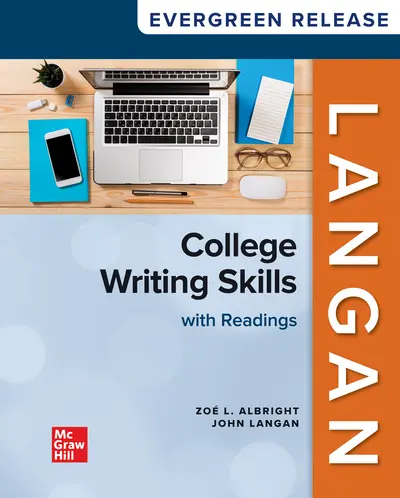
College Writing Skills with Readings emphasizes writing skills as well as process. The text identifies a set of four fundamental skills that are critical to effective writing:
Unity: Discover a clearly stated point, or topic sentence, and make sure that all other information in the paragraph or essay supports that point.
Support: Buttress the points with specific evidence, and plenty of it.
Coherence: Organize and connect supporting evidence so that paragraphs and essays transition smoothly from one piece of supporting information to the next.
Sentence Skills: Revise and edit so that sentences are error-free for clearer and more effective communication. These four bases are essential to all effective writing, whether it be a narrative paragraph for a personal journal, a cover letter for a job application, or an essay for an academic assignment.
McGraw Hill eBooks and digital platforms use an Evergreen delivery model with a release-centered process that makes it easy to keep courses fresh, engaging, and relevant.
Release Notes provide detailed information about new and updated content delivered with each release.
John Langan has taught reading and writing at Atlantic Cape Community College for more than 25 years. The author of a popular series of college textbooks on both writing and reading, John enjoys the challenge of developing instructive materials that are clear and lively. Before teaching, he earned advanced degrees in writing at Rutgers University and in reading at Rowan University. He also spent a year writing fiction that “is now at the back of a drawer waiting to be discovered and acclaimed posthumously.” While in school, he supported himself by working as a truck driver, a machinist, a battery assembler, a hospital attendant, and an apple packer. In addition to his wife and Philly sports teams, his passions include reading and conveying to nonreaders the pleasure and power of books. Through Townsend Press, his educational publishing company, he has developed the nonprofit “Townsend Library”—a collection of more than 100 new and classic stories that appeal to readers of any age.
Zoe L. Albright
Zoé L. Albright has been involved in diverse aspects of education for 22 years. For the last 18 years, she has been a faculty member at Metropolitan Community College–Longview, teaching developmental writing, composition, and literature. She has created and implemented traditional and online curricula for high school and college English and composition courses and for a variety of literature courses. She continues to research new educational theory and practices. Zoé has most recently served as co-author of English Skills with Readings, ninth edition, and contributing author to other Langan texts. She received her M.A. from Goldsmiths, University of London; B.S. and B.A. from the University of Idaho; and A.A. from Cottey College. She is currently pursuing a Ph.D. in Curriculum and Instruction at the University of Kansas. Zoé currently resides outside Kansas City, Missouri, with her husband and teenage son.
Ways of reading
No information about appearance modifiability is available.
Not all of the content will be readable as read aloud speech or dynamic braille.
Has alternative text descriptions for images.
No information about prerecorded audio is available.
Conformance
The publication contains a conformance statement that it meets the EPUB Accessibility and WCAG 2 Level AA standard.
This publication claims to meet EPUB Accessibility 1.1 Web Content Accessibility Guidelines (WCAG) 2.2 Level AA.
Navigation
Table of contents to all chapters of the text via links
Index with links to referenced entries
Elements such as headings, tables, etc for structured navigation
Rich content
Math formulas in accessible format (MathML)
Information-rich images are described by extended descriptions
Hazards
The publication does not contain flashing content that can cause photosensitive seizures.
The publication does not contain motion simulations that can cause motion sickness.
Accessibility summary
Certain images may be essential exceptions (screenshots, medical diagrams, etc.) and thus do not have strong contrast. Boxed sidebars are marked as complementary regions (asides) to aid navigation. In-text references to figures, sections, and pages are linked for easy access however, there are no back links provided. Tables are properly marked up for screen reader compatibility, including summaries for complex tables.
Legal considerations
No information is available.
Additional accessibility information
Color is not the sole means of conveying information
highered What is Evergreen View Edition Updates Move to New Edition View newer edition <p>Hello world</p> What is Evergreen <ul> <li>Rent or purchase for a fraction of the printed textbook price</li> <li>Rental transaction occurs through McGraw Hill's authorized rental partner</li> </ul> <ul> <li>Purchase un-bound 3-ring binder ready textbook</li> <li>Flexibility and ease of selecting chapters to take where you want to go</li> </ul> <ul> <li>Rent or purchase for a fraction of the printed textbook price</li> <li>Easily highlight, take notes and search</li> <li>Download the free ReadAnywhere App for offline access and anytime reading</li> <li><b>Note:</b> the eBook does not include access to Connect. If your instructor assigned Connect, click the "Digital" tab.</li> </ul> Watch a quick video to learn more <p style="text-align: left;">* By purchasing <b>lifetime</b> access to this McGraw Hill eBook title, you have access to the title for as long as it is available through the McGraw Hill Bookshelf website.</p> <ul> <li><b>Note: Connect can only be accessed if your instructor is using Connect in your course.</b></li> <li>Personalize your learning, save time completing homework, and possibly earn a better grade</li> <li>Download free ReadAnywhere App for offline access to eBook for anytime reading</li> <li>Access to eBook, homework and adaptive assignments, videos, and study resources</li> </ul> View Features of Textbook rental Features <ul> <li>Rent for a fraction of the printed textbook price</li> <li>Complete text bound in hardcover or softcover</li> </ul> <div><b> Note:</b> Payment through authorized rental partners</div> View Features of Connect access purchase Features <ul> <li><b>Digital access</b> to a comprehensive online learning platform</li> <li>Includes <b>homework</b>, <b>study tools</b>, <b>eBook, and adaptive assignments</b></li> <li>Download the <b>free </b><a href="/content/mhe/en_us/learning-solutions/digital-solutions/mhebook.html"><span class="link-dark-underline">ReadAnywhere app</span></a> to access the eBook offline</li> <li>Check with your instructor to see if a discounted loose-leaf version is available for purchase within Connect for an additional charge.</li> </ul> View Features of Loose-Leaf purchase Features <ul> <li>Unbound loose-leaf version of full text</li> <li>Discount loose-leaf available within Connect</li> </ul> View shipping options <ul> <li>A <b>personalized </b>and dynamic learning experience</li> <li>Adaptive learning will <b>focus </b>your study time </li> <li>Integrated <b>eBook </b>for additional support</li> <li>Exercise and lecture videos, interactives, and extra practice materials</li> </ul> Features <p>Complete text bound in hardcover or softcover</p> View shipping options Features <p><b>Details</b> </p> <ul> <li>Includes: access to an online learning platform and full printed textbook rental available in hardcover or softcover</li> <li>Access resources and tools in one place: eBook, complete homework, and customized assignments based on your progress</li> <li>Easily access offline or on a mobile device by downloading the free<b> </b><a href="/content/mhe/en_us/learning-solutions/digital-solutions/mhebook.html"><span class="link-dark-underline">ReadAnywhere app</span></a></li> </ul> <ul> <li>Comprehensive online learning platform + unbound loose-leaf print text package</li> <li>Connect includes <b>homework</b>, <b>study tools,</b> <b>eBook, and adaptive assignments</b></li> <li>Download the <b>free </b><a href="/content/mhe/en_us/learning-solutions/digital-solutions/mhebook.html"><span class="link-dark-underline">ReadAnywhere app</span></a> to access the eBook offline</li> </ul> View shipping options Features <p><b>Receive instant access to:</b></p> <ul> <li>Personalize your learning, save time completing homework, and possibly earn a better grade</li> <li>Access to eBook, homework and adaptive assignments, videos, and study resources</li> <li>Diagnostic assessment platform combined with an online homework system</li> <li>Access to algorithmic homework assignments tied to textbook questions</li> <li>Immediate feedback and step-by-step solutions</li> </ul> <ul> <li>Comprehensive online learning platform + unbound loose-leaf print text <b>package</b></li> <li>ALEKS includes <b>videos</b>, <b>interactives</b>, and <b>practice materials</b></li> <li>Integrated <b>eBook </b>for additional support</li> <li><b>Adaptive learning</b> will focus your study time </li> </ul> View shipping options Features Features <ul> <li>Comprehensive online learning platform + bound traditional print text </li> <li>Connect includes <b>homework</b>, <b>study tools</b>, <b>eBook, and adaptive assignments</b></li> <li>Explore the <b>free </b><a href="/content/mhe/en_us/learning-solutions/digital-solutions/mhebook.html"><span class="link-dark-underline">ReadAnywhere app</span></a> app to access the eBook offline</li> </ul> <p><span><b>Note:</b> Connect can only be used if assigned by your instructor. </span></p> Learn more about Connect <p><span><span><span class="link-dark-underline">Learn more about Connect</span></span></span></p> <span><span><b>Note:</b> Does <b>not</b> come with digital platform access (e.g. Connect, ALEKS, SIMnet etc.)</span></span> Learn more about ALEKS 360> View Features of ebook rental Features <ul> <li>Highlight, take notes, and search</li> <li>Download the<b> free </b><a href="/content/mhe/en_us/learning-solutions/digital-solutions/mhebook.html"><span class="link-dark-underline">ReadAnywhere app</span></a> for offline and mobile access</li> </ul> <div>Note:<b> Connect access NOT included.</b> If Connect is required for your course, click the "Connect" tab.</div> Check out this video to learn more about eBooks > Watch to learn more about the eBook <p><u>Watch to learn more about the eBook</u></p> <span><span><b>Note:</b> GO can only be used if assigned by your instructor. <a href="https://www.mheducation.com/highered/go"><span class="link-dark-underline"><b>Learn more about GO</b></span></a></span></span> View features of Mcgraw HIll GO Features <ul> <li><b>Digital access</b> to eBook+ embedded in your school's Learning Management System (LMS)</li> <li>Includes full <b>eBook</b> and chapter questions</li> <li>Download the<b> free</b> <a href="/content/mhe/en_us/learning-solutions/digital-solutions/mhebook.html" target="_self"><span class="link-dark-underline">ReadAnywhere app</span></a> for offline and mobile access</li> </ul> <p style="padding-bottom: 16px; margin-bottom: 0px;"> <span> <strong>eBook Features:</strong> </span> </p> <ul style="list-style: none; padding-left: 0; margin: 0;"> <li style="padding-bottom: 16px; margin-bottom: 0px; display: table; width: 100%;"> <span style="color: #E21A23; display: table-cell; width: 16px; padding-right: 7px; vertical-align: top;"> <uxt-icon icon="check-circle-fill"></uxt-icon> </span> <span style="display: table-cell; vertical-align: top;"> Normally the lowest price option for student </span> </li> <li style="padding-bottom: 16px; margin-bottom: 0px; display: table; width: 100%;"> <span style="color: #E21A23; display: table-cell; width: 16px; padding-right: 7px; vertical-align: top;"> <uxt-icon icon="check-circle-fill"></uxt-icon> </span> <span style="display: table-cell; vertical-align: top;"> Integrates in your LMS </span> </li> <li style="padding-bottom: 16px; margin-bottom: 0px; display: table; width: 100%;"> <span style="color: #E21A23; display: table-cell; width: 16px; padding-right: 7px; vertical-align: top;"> <uxt-icon icon="check-circle-fill"></uxt-icon> </span> <span style="display: table-cell; vertical-align: top;"> Accessible tools for students, including read-aloud functionality, jump links and dynamic note-taking and highlighting features </span> </li> </ul> <p style="padding-bottom: 16px; margin-bottom: 0px;"> <span> <strong>Connect Features:</strong> </span> </p> <ul style="list-style: none; padding-left: 0; margin: 0;"> <li style="padding-bottom: 16px; margin-bottom: 0px; display: table; width: 100%;"> <span style="color: #E21A23; display: table-cell; width: 16px; padding-right: 7px; vertical-align: top;"> <uxt-icon icon="check-circle-fill"></uxt-icon> </span> <span style="display: table-cell; vertical-align: top;"> Integrates in your LMS. </span> </li> <li style="padding-bottom: 16px; margin-bottom: 0px; display: table; width: 100%;"> <span style="color: #E21A23; display: table-cell; width: 16px; padding-right: 7px; vertical-align: top;"> <uxt-icon icon="check-circle-fill"></uxt-icon> </span> <span style="display: table-cell; vertical-align: top;"> Prebuilt courses, presentation slides and instructor resources. </span> </li> <li style="padding-bottom: 16px; margin-bottom: 0px; display: table; width: 100%;"> <span style="color: #E21A23; display: table-cell; width: 16px; padding-right: 7px; vertical-align: top;"> <uxt-icon icon="check-circle-fill"></uxt-icon> </span> <span style="display: table-cell; vertical-align: top;"> Test question banks, adaptive assignments, essay prompts, video content and more interactive exercises specific to your course subject. </span> </li> <li style="padding-bottom: 16px; margin-bottom: 0px; display: table; width: 100%;"> <span style="color: #E21A23; display: table-cell; width: 16px; padding-right: 7px; vertical-align: top;"> <uxt-icon icon="check-circle-fill"></uxt-icon> </span> <span style="display: table-cell; vertical-align: top;"> eBook access (with included <a href="/content/mheducation/us/en/highered/digital-products/mhebook">ReadAnywhere app</a>). </span> </li> <li style="padding-bottom: 16px; margin-bottom: 0px; display: table; width: 100%;"> <span style="color: #E21A23; display: table-cell; width: 16px; padding-right: 7px; vertical-align: top;"> <uxt-icon icon="check-circle-fill"></uxt-icon> </span> <span style="display: table-cell; vertical-align: top;"> Print book add-on availability. </span> </li> <li style="padding-bottom: 16px; margin-bottom: 0px; display: table; width: 100%;"> <span style="color: #E21A23; display: table-cell; width: 16px; padding-right: 7px; vertical-align: top;"> <uxt-icon icon="check-circle-fill"></uxt-icon> </span> <span style="display: table-cell; vertical-align: top;"> Remote proctoring. </span> </li> </ul> Connect - Take a Tour Connect - Take a Tour Connect - Take a Tour Take a Tour Connect - Take a Tour Connect - Learn More Connect - Learn More Connect - Learn More Learn More Connect - Learn More <p>Connect supports instructors in guiding students to work through challenges - not around them - building real readiness grounded in critical thinking, application, and lasting skills.</p> <p>With integrated course materials, assignments, and interactive tools, instructors can streamline course management while creating more meaningful learning experiences while saving time. Login or join Connect to discover resources built to support you. </p> <p>Every Connect title includes tools and resources to support teaching and learning. Below are some of the available features for your course.</p> LMS Integration Prebuilt Course Materials Adaptive Assignments eBook Access Print Add-On Remote Proctoring <h3>Learn how Connect can enhance your course </h3> Explore Assignments for Your Course <p style="padding-bottom: 16px; margin-bottom: 0px;"> <span> <strong>Print Features:</strong> </span> </p> <ul style="list-style: none; padding-left: 0; margin: 0;"> <li style="padding-bottom: 16px; margin-bottom: 0px; display: table; width: 100%;"> <span style="color: #E21A23; display: table-cell; width: 16px; padding-right: 7px; vertical-align: top;"> <uxt-icon icon="check-circle-fill"></uxt-icon> </span> <span style="display: table-cell; vertical-align: top;"> Rentable options available for student use </span> </li> <li style="padding-bottom: 16px; margin-bottom: 0px; display: table; width: 100%;"> <span style="color: #E21A23; display: table-cell; width: 16px; padding-right: 7px; vertical-align: top;"> <uxt-icon icon="check-circle-fill"></uxt-icon> </span> <span style="display: table-cell; vertical-align: top;"> Hardcopy and softcover formats available </span> </li> </ul> <p style="padding-bottom: 16px; margin-bottom: 0px;"> <span> <strong>Go Features:</strong> </span> </p> <ul style="list-style: none; padding-left: 0; margin: 0;"> <li style="padding-bottom: 16px; margin-bottom: 0px; display: table; width: 100%;"> <span style="color: #E21A23; display: table-cell; width: 16px; padding-right: 7px; vertical-align: top;"> <uxt-icon icon="check-circle-fill"></uxt-icon> </span> <span style="display: table-cell; vertical-align: top;"> Integrates in your LMS. </span> </li> <li style="padding-bottom: 16px; margin-bottom: 0px; display: table; width: 100%;"> <span style="color: #E21A23; display: table-cell; width: 16px; padding-right: 7px; vertical-align: top;"> <uxt-icon icon="check-circle-fill"></uxt-icon> </span> <span style="display: table-cell; vertical-align: top;"> Assignable readings. </span> </li> <li style="padding-bottom: 16px; margin-bottom: 0px; display: table; width: 100%;"> <span style="color: #E21A23; display: table-cell; width: 16px; padding-right: 7px; vertical-align: top;"> <uxt-icon icon="check-circle-fill"></uxt-icon> </span> <span style="display: table-cell; vertical-align: top;"> Auto-graded chapter questions. </span> </li> </ul> Go - Take a Tour Go - Take a Tour Go - Take a Tour Take a Tour Go - Take a Tour Go - Learn More Go - Learn More Go - Learn More Learn More Go - Learn More <p style="padding-bottom: 16px; margin-bottom: 0px;"> <span> <strong>Print Features:</strong> </span> </p> <ul style="list-style: none; padding-left: 0; margin: 0;"> <li style="padding-bottom: 16px; margin-bottom: 0px; display: table; width: 100%;"> <span style="color: #E21A23; display: table-cell; width: 16px; padding-right: 7px; vertical-align: top;"> <uxt-icon icon="check-circle-fill"></uxt-icon> </span> <span style="display: table-cell; vertical-align: top;"> Free instructor sample copy </span> </li> <li style="padding-bottom: 16px; margin-bottom: 0px; display: table; width: 100%;"> <span style="color: #E21A23; display: table-cell; width: 16px; padding-right: 7px; vertical-align: top;"> <uxt-icon icon="check-circle-fill"></uxt-icon> </span> <span style="display: table-cell; vertical-align: top;"> Hardcopy and softcover formats available </span> </li> </ul> <p style="padding-bottom: 16px; margin-bottom: 0px;"> <span> <strong>Connect Loose-Leaf Features:</strong> </span> </p> <ul style="list-style: none; padding-left: 0; margin: 0;"> <li style="padding-bottom: 16px; margin-bottom: 0px; display: table; width: 100%;"> <span style="color: #E21A23; display: table-cell; width: 16px; padding-right: 7px; vertical-align: top;"> <uxt-icon icon="check-circle-fill"></uxt-icon> </span> <span style="display: table-cell; vertical-align: top;"> Comprehensive online learning platform + unbound loose-leaf print text package. </span> </li> <li style="padding-bottom: 16px; margin-bottom: 0px; display: table; width: 100%;"> <span style="color: #E21A23; display: table-cell; width: 16px; padding-right: 7px; vertical-align: top;"> <uxt-icon icon="check-circle-fill"></uxt-icon> </span> <span style="display: table-cell; vertical-align: top;"> Connect includes <strong>homework</strong>, <strong>study tools,</strong> <strong>eBook, and adaptive assignments</strong>. </span> </li> <li style="padding-bottom: 16px; margin-bottom: 0px; display: table; width: 100%;"> <span style="color: #E21A23; display: table-cell; width: 16px; padding-right: 7px; vertical-align: top;"> <uxt-icon icon="check-circle-fill"></uxt-icon> </span> <span style="display: table-cell; vertical-align: top;"> Download the <strong>free </strong><a href="https://www.mheducation.com/highered/learning-solutions/digital-solutions/mhebook.html">ReadAnywhere app</a> to access the eBook offline. </span> </li> </ul> Features <ul> <li>Highlight, take notes, and search</li> <li>Download the<b> free </b><a href="/content/mhe/en_us/learning-solutions/digital-solutions/mhebook.html"><span class="link-dark-underline">ReadAnywhere app</span></a> for offline and mobile access</li> </ul> <div>Note:<b> Connect access NOT included.</b> If Connect is required for your course, click the "Connect" tab.</div> Check out this video to learn more about eBooks > Watch to learn more about the eBook <p><u>Watch to learn more about the eBook</u></p> <p style="padding-bottom: 16px; margin-bottom: 0px;"> <span> <strong>Print Features:</strong> </span> </p> <ul style="list-style: none; padding-left: 0; margin: 0;"> <li style="padding-bottom: 16px; margin-bottom: 0px; display: table; width: 100%;"> <span style="color: #E21A23; display: table-cell; width: 16px; padding-right: 7px; vertical-align: top;"> <uxt-icon icon="check-circle-fill"></uxt-icon> </span> <span style="display: table-cell; vertical-align: top;"> Free instructor sample copy </span> </li> <li style="padding-bottom: 16px; margin-bottom: 0px; display: table; width: 100%;"> <span style="color: #E21A23; display: table-cell; width: 16px; padding-right: 7px; vertical-align: top;"> <uxt-icon icon="check-circle-fill"></uxt-icon> </span> <span style="display: table-cell; vertical-align: top;"> Hardcopy and softcover formats available </span> </li> </ul> eBook Print Connect ALEKS GO GDP Online Only <p><span class="fs-small">* The estimated amount of time this product will be on the market is based on a number of factors, including faculty input to instructional design and the prior revision cycle and updates to academic research-which typically results in a revision cycle ranging from every two to four years for this product. Pricing subject to change at any time.</span></p> <h2><span class="h3"><span class="fw-semibold">Instructor Information</span></span></h2> <h2><span><span class="fs-5"><span class="fw-bolder">Instructor Quick Actions</span></span></span></h2> text Instructor Quick Actions Get Access Get access as soon as you validate! Request Sample Get a copy as soon as validated. Find Rep Find a local rep best suited for you. <h2><span class="fs-5"><span class="fw-bolder">Product Information</span></span></h2> <p>First accordion item</p> Overview Release Notes Table of Contents Author Bios Accessibility Affordability <p>McGraw Hill eBooks and digital platforms use an Evergreen delivery model with a release-centered process that makes it easy to keep courses fresh, engaging, and relevant.</p> <p>Release Notes provide detailed information about new and updated content delivered with each release.</p> <p>Your account requires validation. Please <a href="https://www.mheducation.com/highered/support/find-your-rep">contact your sales representative</a>.</p> <h2><span class="h3">Accessibility</span></h2> Review this product's accessibility information <p>Creating accessible products is a priority for McGraw Hill. We make accessibility and adhering to WCAG AA guidelines a part of our day-to-day development efforts and product roadmaps.</p> <p>For more information, visit our <a href="/content/highered/en_us/accessibility.html" target="_self">accessibility page</a>, or contact us at <a href="mailto:accessibility@mheducation.com">accessibility@mheducation.com</a></p> affordability icon <h2><span class="h3">Affordability</span></h2> Learn more about Inclusive Access <p>Reduce course material costs for your students while still providing full access to everything they need to be successful. It isn't too good to be true - it's Inclusive Access.</p> <p style="text-align: center;"><strong>Need support?</strong> We're here to help - <a href="/content/mheducation/us/en/highered/support/support-at-every-step.html" target="_self">Get real-world support and resources every step of the way.</a></p>