


 91 / 121

Chris Johnson/Alamy Stock Photo
C
C
C
S
E
P
D
C
I
PLAN AND CONDUCT AN
INVESTIGATION
Work with a partner to conduct a quadrat
sampling population count on an area of one
square meter. Record your data in a table.
Discuss how to use your data to estimate the
total population.
As Easy (or Not) as 1, 2, 3
Complete Counts, Sampling,
and Indirect Counts
With a
complete count,
scientists count every
member of a population. They can use an
airplane to fly over a population and take
photographs of its members, or they can walk
across an area and count every population
member they see. With
sampling
, scientists
count a small number of population members
and use that number to estimate the total
population. With an
indirect count
, scientists
count signs left by a population—such as
scat, nests, and dens—instead of counting the
actual members of the population.
Quadrat sampling
is used with plant species,
which do not move, or with animal species
that move very slowly. Scientists count all
members of a population in a specific area
(called a quadrat) and then extrapolate to
estimate the total population. In
transect
sampling
, scientists “draw” lines across an
area instead of marking off a quadrat. They
walk the lines and count the plants or animals
they see along the lines. They use those
numbers to estimate the total population.
Mark-recapture
Mark-recapture
is a sampling method used
with animals. Scientists capture members of a
population, tag them, and release them.
Later, scientists recapture population
members. They count the number of
untagged and already-tagged animals. They
then use these numbers to determine a ratio
(tagged to untagged animals) and extrapolate
that to an estimation of the total population.
Biologists and other scientists often count
populations of organisms as part of their
work in the field. There are several different
methods scientists can use to determine or
estimate a population count.
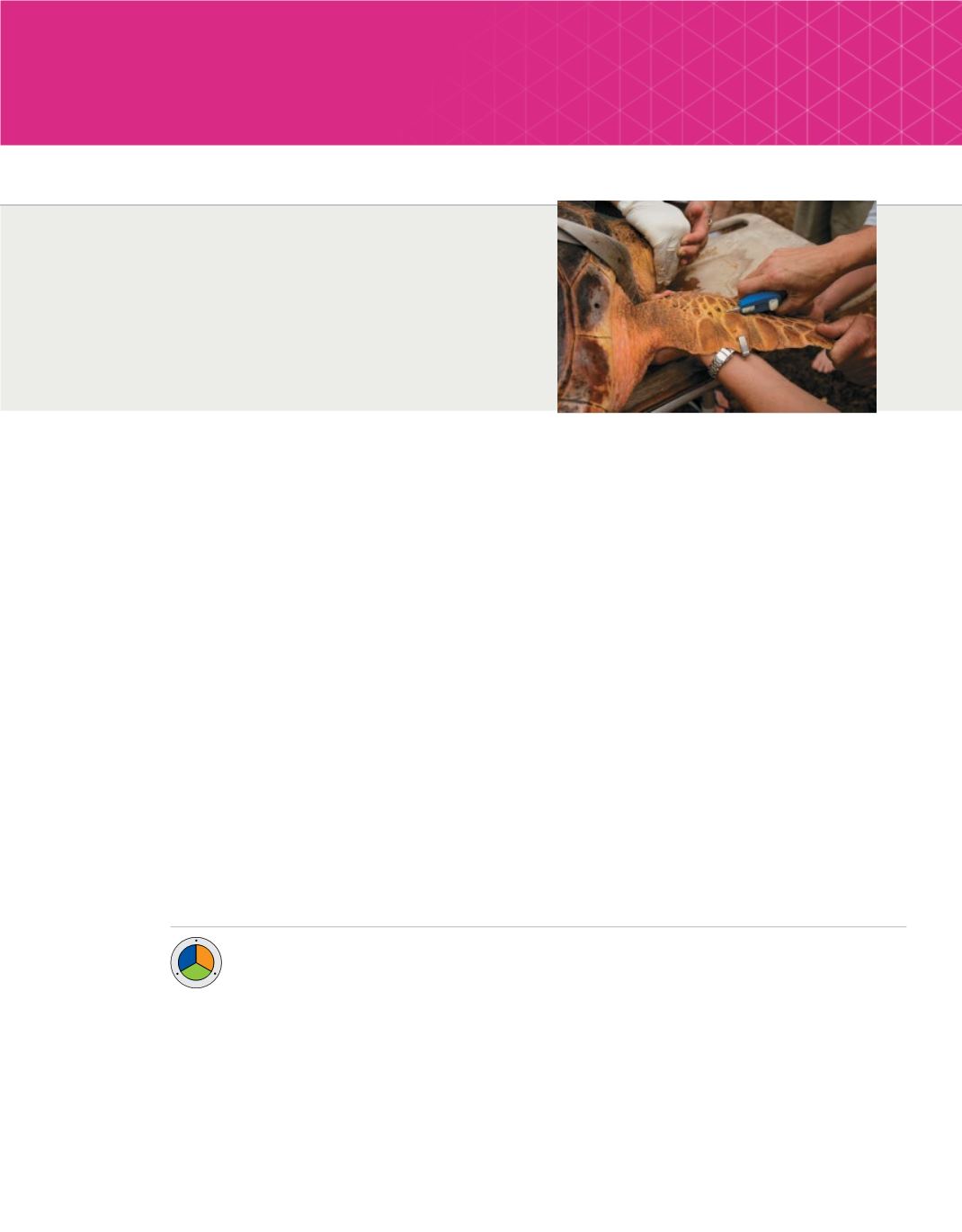
In mark-recapture sampling, scientists often insert a
passive integrated transponder into an animal to record
information on its growth, movements, and survival.
STEM AT WORK
Module 4 • STEM at Work
93