
Locate Actively Learn ELA Units and Text Sets
Learn how teachers find and use Actively Learn units and text sets to organize sequenced lessons and build meaningful, standards‑aligned instruction.
- PreK-12
- Customer Support
- Classroom Teacher
- Elementary School
- Middle School
- High School
- Direct Login & Auto-Rostering
- Direct Login & Manual-Rostering
- SSO & Auto-Rostering
- SSO & Manual-Rostering
- Supplemental
- Literacy
- Actively Learn
- Plan & Present
- Tools & Resources


Article Contents
Units & Text Sets
Actively Learn makes it easy for teachers to find curriculum materials to add to their classes with our sequenced curriculum units which consists of units for elementary, middle, and high school levels.
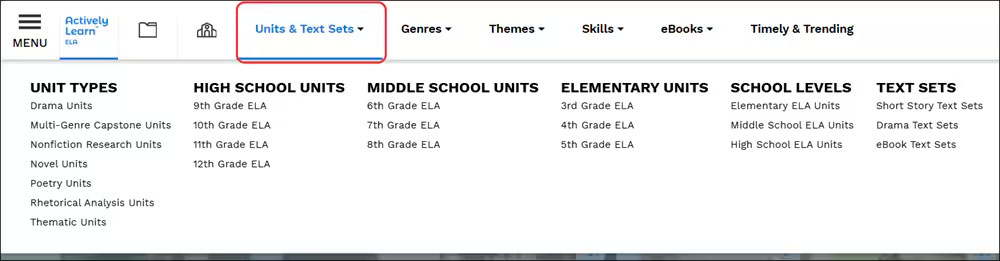
Teachers can find the available units for ELA by hovering over Units & Text Sets in the navigation menu and clicking on an available option.
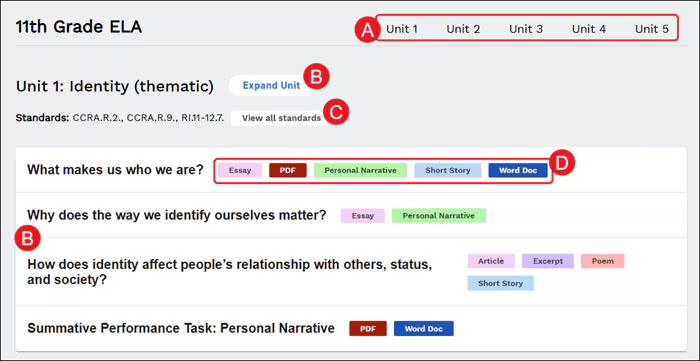
Each ELA unit is broken down by unit sections and into individual lessons, which include:
- Description of the assignment and how it fits in with the other assignments in the unit.
- Link to the assignment(s) in the content catalog.
- The aligned standards in the assignment(s).
A. Click on a Unit from the top-right to navigate directly to that selection.
B. Click the Expand/Collapse Unit button to open/close all unit sections at once or click on an individual blade to expand/collapse the section.
C. Click the View all standards button to view a pop-up with all associated standards for the unit and their descriptions.
D. The majority of the unit blades will also consist of tags indicating the type of resources available within that section.
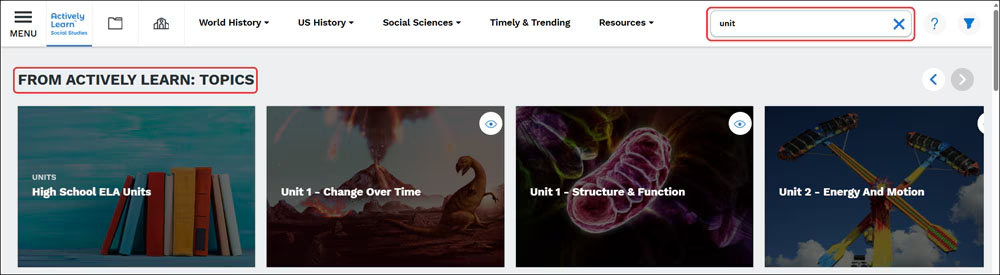
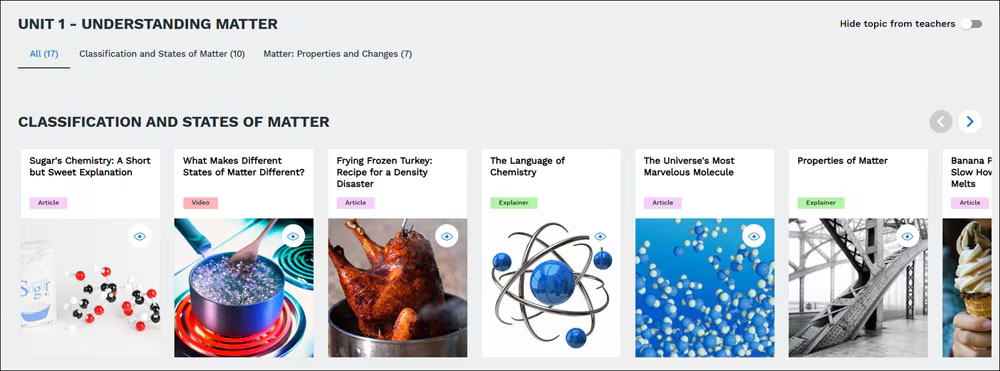
For Social Studies and Science units, they can be found by doing a search for "Units" in the Search field of the subject's catalog and locating the preferred unit in the From Actively Learn: Topics section.
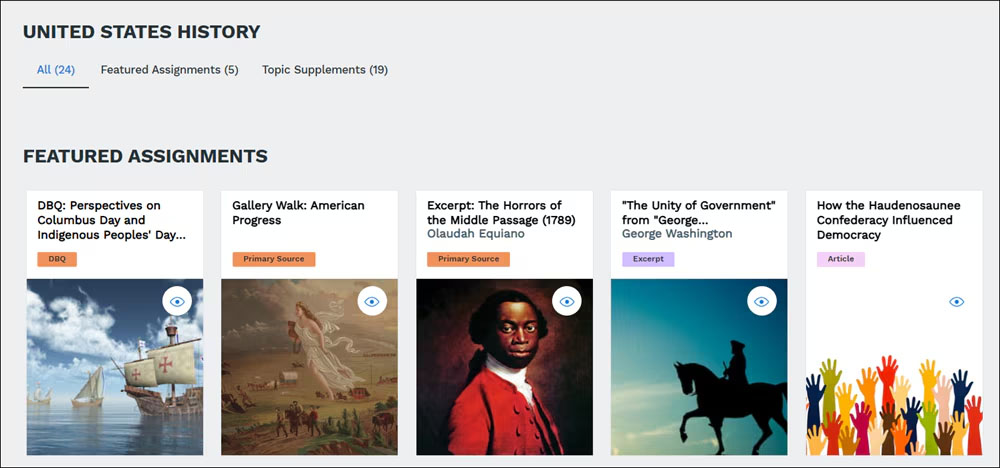
These units will be broken down into different sections such as Featured Assignments, Topic Supplements, and various resource sections.
Social Studies View
Science View
Text Set Tips
Here are some tips to help teachers think about putting together their own text sets for topics that they'd like to explore with their students.
First, determine an objective for the entire text set (can be related to a topic, standard, anchor text, etc.).
Example objectives:
- Students will understand the events and public attitudes leading to the internment of Japanese-Americans during WWII.
- Students will identify the elements of persuasive writing and evaluate an argument based on the author’s reasoning and evidence.
- Students will examine how global warming is affecting different regions and populations around the world.
Next, select and sequence texts to build critical content/background knowledge or create meaningful connections to the anchor text.
Tips for selecting text:
- Choose rich and engaging texts that allow students build knowledge or practice skills related to the learning objective.
- Include texts that provide different perspectives or unfamiliar views on a topic.
- Vary text type (informational vs. literary), length, and format.
- Consider text complexity.
Tips for sequencing text:
- Order texts in a way that encourages students to make meaningful connections between them or the
anchor text.
- Scaffold skills -- e.g., For a set related to character analysis, begin with a text that includes more examples of direct characterization before introducing texts with indirect characterization.
- Start with texts that provide background knowledge about a topic or issue.
Finally, add instruction (notes and questions) to each text -- provide opportunities for formative assessment, feedback, and scaffolding.
Sample:
- Overarching Objective: Students will identify the elements of persuasive writing and evaluate an argument based on the author’s reasoning and evidence.
- Text 1: Identify elements of persuasive writing; evaluate author’s credibility
- Text 2: Examine the structure of an argument; evaluate the evidence presented
- Texts 3 & 4: Examine counter-arguments; compare and contrast perspectives and
evidence
