Actively Learn Social Studies Document-Based (DBQ) Assignments
Create and deliver Social Studies document-based assessments in Actively Learn.
- PreK-12
- Customer Support
- Classroom Teacher
- Middle School
- High School
- Direct Login & Auto-Rostering
- Direct Login & Manual-Rostering
- SSO & Auto-Rostering
- SSO & Manual-Rostering
- Supplemental
- Social Studies
- Actively Learn
- Grades & Assignments
- Online Assessments


Designed to support teaching within the C3 Framework, the Social Studies Document-Based Assignments are rigorously designed to require students to perform the work of historians rather than memorize facts and sequences of events. Students must use their prior knowledge and historical thinking skills to analyze multiple documents and answer an open-ended compelling question. DBQ assignments are available for every middle school and high school social studies unit.
For each assignment, our team of historians, writers, and former educators carefully considered what question would drive to the heart of some of the major themes of that time period. Here are some examples:
US History
- Following the Civil War, did the US live up to the ideals upon which it was founded?
- How did WWII advance the fight for civil rights in America?
- Did activists in the 1960s and 1970s uphold or challenge American values?
World History
- Did Empress Wu uphold the Mandate of Heaven?
- Was Galileo a rebel?
- Was the American or French Revolution more representative of Enlightenment ideals?
- Who deserves credit for ending the Cold War?
- How did Mansa Musa help the Mali Empire reach new heights?
Our team then curated sources that would present students with diverse perspectives on the question. Our goal was to provide students with enough evidence to gain an understanding of the complexity of the question while requiring them to develop their own opinion on the answer. To answer the final essay question, students must evaluate the sources, develop an argument, and cite evidence.
Article Contents
Where can you find these DBQ Assignments?
How do these assignments work, and how are they different from other assignments on Actively Learn?
What should my students know before I assign a DBQ Assignment?
What should I do after my students take a DBQ Assignment?
Where can you find these DBQ Assignments?
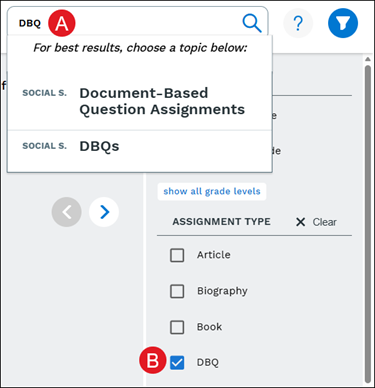
The quickest way to locate DBQ assignments, enter "DBQ" into the Search field (A) or select DBQ from the Assignment Type filter (B).
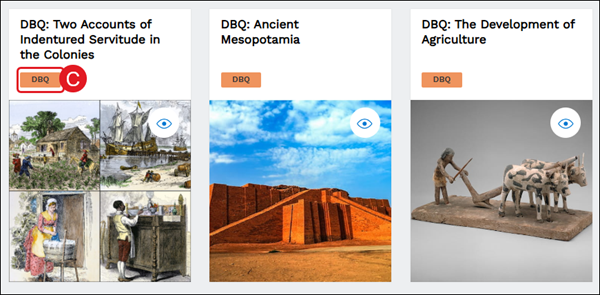
DBQ resources will have a label (C) under the title of the resource.
What is in a DBQ Assignment?
DBQ assignments include a series of primary and secondary sources that students will need to analyze and interpret.
- Each assignment includes four to six primary and secondary sources that will deepen students’ understanding of the time period by exposing them to diverse voices from history.
- Middle school assignments include four documents.
- High school assignments include six documents.
- Multiple-choice questions after every document require students to analyze each source before moving on. These questions help prepare students for the final essay question.
- A final essay question requires students to draw on evidence from multiple documents. The final essay question does not have one correct answer. Rather, this open-ended question is intended to be compelling, prompt curiosity, and require argumentation with textual evidence and historical knowledge.
For steps on creating DBQ assignments, refer to the Create, Duplicate, Merge, and Import Actively Learn Assignments article.
How do these assignments work, and how are they different from other assignments on Actively Learn?
These assignments take place on Actively Learn and include multiple-choice questions and extended-response questions. These assignments are designed to test student comprehension of core concepts in science or social studies via a test-tasking environment. These assignments differ from other Actively Learn assignments in the following ways:
- Students cannot access collaboration features but can take notes, define unfamiliar words, and translate text.
- Students can take notes in the text but will not be able to share notes with other students or see feedback on questions as they work.
- Teachers can turn off any of the student reading aids in the assignment reading settings.
- Teachers can assess student understanding through long-form essay questions.
- Some assignments include long-form essay questions to assess students' understanding of a broader concept or problem.
- These essay questions have a much higher point value than other questions by default.
What should my students know before I assign a DBQ Assignment?
Students should have a general understanding of the time period before tackling the DBQ assignments. These assignments work well for teachers following the Actively Learn units but are flexible and general enough for teachers following their own curriculum.
Students should also be familiar with evaluating and analyzing primary sources. They should understand the importance of considering who wrote a source, when it was written, who it was written for, and the general historical context. They should also be familiar with interpreting visual secondary sources such as maps and graphs.
What should I do after my students take a DBQ Assignment?
These tasks are compelling and complex. They offer ample opportunity for discussion and debate even after all the grades are in.
Every class and teacher is different, but here are some considerations for how you can debrief:
- You can use class data on Actively Learn to identify the multiple-choice questions your students performed well on and the ones they struggled with.
- Consider reviewing one or two multiple-choice questions in-depth as a full class after all students have completed the assignment.
- The final essay question is open-ended and often debatable.
- Consider having students share their ideas after all assignments are graded. They could share informally in small groups or more formally in a class debate, presentation, or discussion.
- Student responses to the final essay question could be just the beginning.
- Consider having students conduct peer reviews and then revise their work. They can submit polished final drafts after incorporating feedback.
- The primary and secondary sources provide opportunities for discussing what makes a source trustworthy, why different people have different perspectives on the same topic, and how historians can evaluate sources that are conflicting.
- Consider ways you can reinforce the skills of history with students by reviewing the documents together, discussing the multiple-choice questions, and sharing ideas in response to the final essay question.
