* The estimated amount of time this product will be on the market is based on a number of factors, including faculty input to instructional design and the prior revision cycle and updates to academic research-which typically results in a revision cycle ranging from every two to four years for this product. Pricing subject to change at any time.

Instructor Quick Actions

Get eBook Access Get access as soon as you validate!
Contact a Rep Find a local rep best suited for you.
Find Rep

Product Information

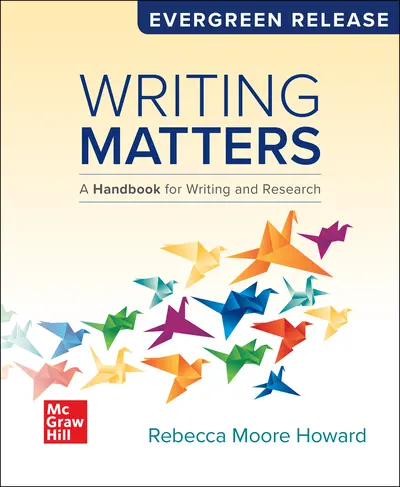
Writing Matters offers instructors and students an accessible four-part framework that focuses the rules and conventions of writing through a lens of responsibility, ultimately empowering students to own their ideas and to view their writing as consequential. Writing Matters emphasizes writing as a set of authors' responsibilities: to other writers by using sources fairly and creating original work; to their audience by writing clearly, designing accessibly, and offering necessary insights; to their topic by exploring it thoroughly, assessing sources carefully, and providing reliable depth; and to themselves by treating writing as a learning process and contributing meaningfully to larger discussions.

McGraw Hill eBooks and digital platforms use an Evergreen delivery model with a release-centered process that makes it easy to keep courses fresh, engaging, and relevant.

Release Notes provide detailed information about new and updated content delivered with each release.

Your account requires validation. Please contact your sales representative.

  • Part One: Planning Drafting, Revising, Editing, Proofreading, and Formatting
  • 1: Writing Responsibly, Writing Successfully
  • 2: Planning Your Project
  • 3: Organizing and Drafting Your Project
  • 4: Crafting and Connecting Paragraphs
  • 5: Drafting and Revising Visuals
  • 6: Revising, Editing, Proofreading, and Formatting
  • Part Two: Reasoning Matters: Reading, Thinking, and Arguing
  • 7: Thinking and Reading Critically
  • 8: Applying Analysis and Crafting Arguments
  • Part Three: Media Matters: Designing, Writing, and Presenting
  • 9: Designing Accessible Print and Digital Documents
  • 10: Writing for Multiple Media
  • 11: Presenting with Multiple Media
  • Part Four: Research Matters: Finding, Evaluating, and Citing Sources
  • 12: Planning a Research Project
  • 13: Finding Information
  • 14: Evaluating Information
  • 15: Overcoming Fear of Plagiarizing: Paraphrase, Summary, and Rhetorical Note-Taking
  • 16: Writing the Research Project
  • 17: Citing Rhetorically
  • Part Five: Documentation Matters
  • 18: Documenting Sources: MLA Style
  • 19: Documenting Sources: APA Style
  • 20: Documenting Sources: Chicago Style
  • 21: Documenting Sources: CSE Style
  • Part Six: Genre Matters: Writing in and Beyond College
  • 22: Writing in Literature and Other Humanities
  • 23: Writing in the Sciences and Social Sciences
  • 24: Preparing for and Taking an Essay Exam
  • 25: Professional and Civic Writing
  • Part Seven: Style Matters: Writing Engagingly
  • 26: Writing Concisely
  • 27: Using Coordination and Subordination
  • 28: Using Parallelism
  • 29: Engaging Readers with Variety and Emphasis
  • 30: Choosing Appropriate Language
  • 31: Choosing Effective Words
  • 32: Using the Dictionary and Spelling Correctly
  • Part Eight: Grammar Matters: Writing with Clarity
  • 33: Understanding Grammar
  • 34: Avoiding Sentence Fragments
  • 35: Avoiding Comma Splices and Fused Sentences
  • 36: Maintaining Agreement
  • 37: Using Verbs
  • 38: Understanding Pronoun Case and Reference
  • 39: Using Adjectives and Adverbs
  • 40: Avoiding Confusing Shifts
  • 41: Avoiding Misplaced and Dangling Modifiers
  • 42: Avoiding Mixed and Incomplete Constructions
  • Part Nine: Language Matters: Guidance for Multilingual Writers
  • 43: Understanding English Word Order and Sentence Structure
  • 44: Using Nouns and Noun Determiners
  • 45: Managing English Verbs
  • 46: Managing Adjectives and Adverbs
  • 47: Using Prepositions
  • Part Ten: Detail Matters: Punctuation and Mechanics
  • 48: Using Commas
  • 49: Using Semicolons
  • 50: Using Apostrophes
  • 51: Using Quotation Marks
  • 52: Using End Punctuation: Periods, Question Marks, and Exclamation Points
  • 53: Using Other Punctuation: Dashes, Parentheses, Brackets, Colons, Ellipses, and Slashes
  • 54: Capitalizing
  • 55: Italics and Underlining
  • 56: Using Abbreviations
  • 57: Using Numbers
  • 58: Using Hyphens

About the Author

Rebecca Moore Howard

Accessibility

Creating accessible products is a priority for McGraw Hill. We make accessibility and adhering to WCAG AA guidelines a part of our day-to-day development efforts and product roadmaps.

For more information, visit our accessibility page, or contact us at accessibility@mheducation.com

affordability icon

Affordability

Reduce course material costs for your students while still providing full access to everything they need to be successful. It isn't too good to be true - it's Inclusive Access.

Need support?   We're here to help - Get real-world support and resources every step of the way.

Top