


 7 / 121

v
Copyright © McGraw-Hill Education
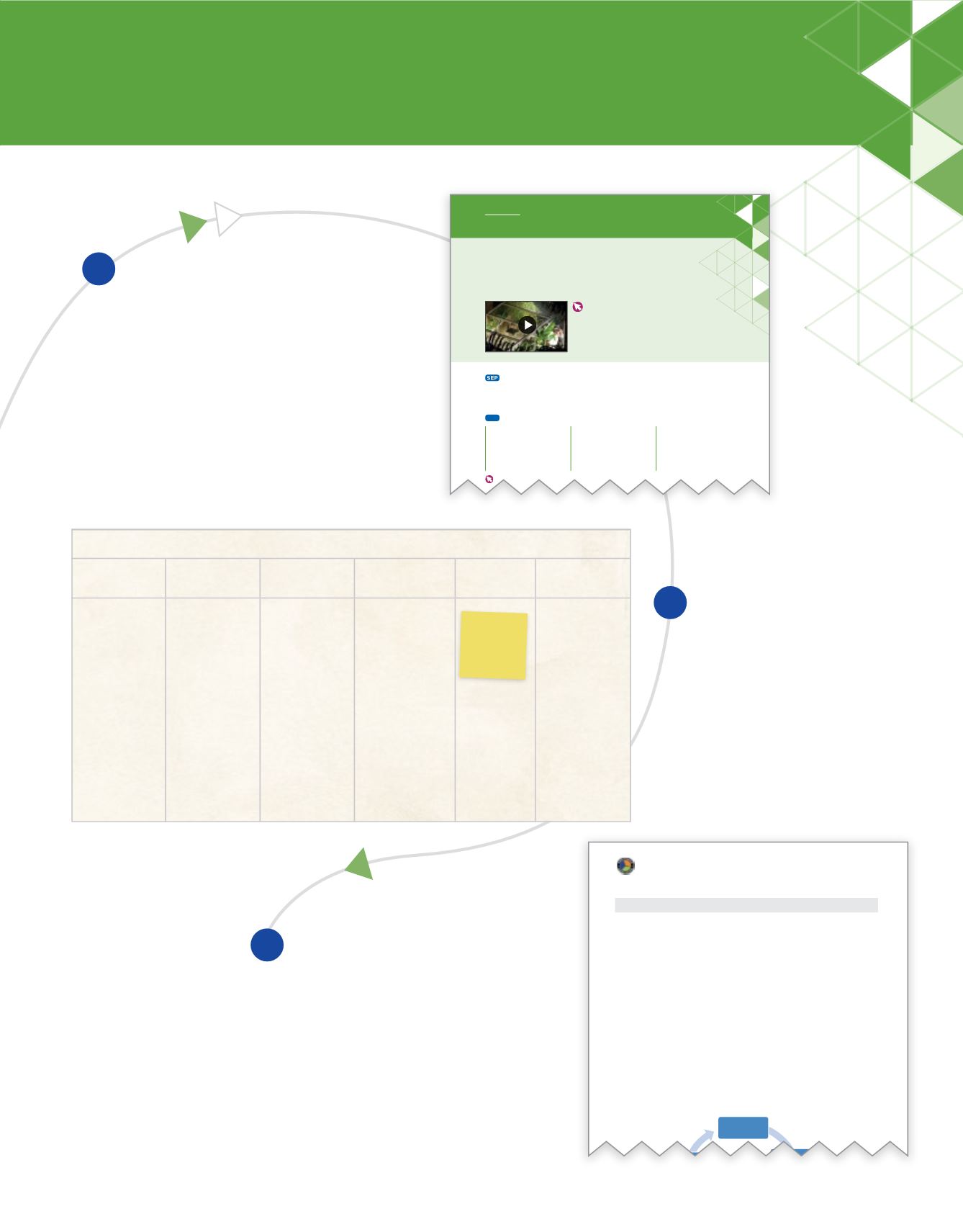
3
Claim, Evidence, Reasoning
As you investigate each phenomenon,
you will write your claim, gather
evidence by performing labs and
completing reading assignments and
Applying Practices, and explain your
reasoning to answer the unit and
module phenomena.
4
Summarize Your Work
When you collect evidence,
you can record your data
in a summary table and
use the data to collaborate
with others to answer the
questions you had.
5
Apply Your Evidence
and Reasoning
At the end of the unit, modules, and
lessons, you can use all of the data
you collected to help complete your
STEM Unit Project.
SUMMARY TABLE
Activity
Model
Observation
Evidence
Explanation
Reasoning
Connection
to Phenom
Questions
Answered
New
Questions
Applying
Practices:
Modeling
Photosynthesis
The
reactants of
photosynthesis
are CO
2
, H
2
O,
and sunlight;
the products
are sugar and
O
2
.
Photosynthesis
allows
autotrophs to
convert energy
from the Sun
to chemical
energy that
is stored in
sugar.
Unit:
Photosynthesis
is one of
the cellular
processes
needed to keep
plants alive.
Module:
A greenhouse
optimizes the
conditions
for plants to
photosynthesize.
How fast does
photosynthesis
occur?
Biology STEM Unit 2 Project
Algae Infestation Remediation
Teacher Project Materials
NGSSStandards:
HS-LS1-5,HS-ESS2-6,HS-ESS3-4,HS-ETS1-2,HS-ETS1-3
Materials Per Group
•
4pintsofpreparedalgae culture
solution*
•
Copper sulfate**
•
Lime**
•
Potassiumpermanganate**
•
Barley straw**
•
Coffee filters**
•
Activated carbon**
*PreparedAlgaeCultureSolutionProcedure:
Approximatelyoneweekprior to students’ testingof their remediation solutions,prepareenough
algal culture for the class. It ispreferable topurchasealgae froma localoreducational supplier.
1. Drawhot tapwater intogallon container(s)andputaside foroneday.
2. Add the culture sample to the tapwater thathasbeen sitting foroneday.
3. Afterapproximatelyoneweek,divide thegallon(s)ofalgal culture into small clear
containersapproximatelyonepinteach for the students touseduring testingof their
solutions.Eachgroup shouldhaveapproximately four separatepints touse,oneasa
control,and three for testing.
**Materials canbe researchedby studentsasmaterials thatareused inalgae controland canbe
madeavailableas resources for theproblem-solving task.
Prior to the start of the activity, review the following key concepts:
•
Photosynthesis
•
Biogeochemical cycles
•
Human impactonnatural systems
•
Biomass
IdentifyProblemor
Need
(30minutes)
DefineProblemor
NeedUsing
Constrains
(30minutes)
Researchand
Brainstorming
(90minutes)
Testingand
Analysis
(75minutes)
Evaluationand
Presentation
(60minutes)
Developmentof
How do plants
turn light
energy into
food?
0196-0196_Bio_CA_S_CH08_MO_674237.indd
03/01/19 05:29PM 0196-0196_Bio_CA_S_CH08_MO_674237.indd
03/01/19 05:29PM
MODULE 8
CELLULAR ENERGY
ENCOUNTER THE PHENOMENON
Why would a farmer grow
lettuce in a greenhouse?
GO ONLINE
to watch a video about
how energy is transferred in plants.
Ask Questions
Do youhaveotherquestionsabout thephenomenon? If so,add them to thedriving
questionboard.
CER
Claim, Evidence, Reasoning
MakeYourClaim
Use your
CER chart tomakea claim
aboutwhya farmerwould
growplants inagreenhouse.
Explain your reasoning.
CollectEvidence
Use the
lessons in thismodule to
collectevidence to support
your claim.Record your
evidenceas youmove
through themodule.
ExplainYourReasoning
You
will revisit your claimand
explain your reasoningat the
endof themodule.
GOONLINE
toaccessyourCERchartandexplore resources thatcanhelpyoucollect
evidence.
LESSON3:Explore&Explain:
OverviewofCellularRespiration
LESSON2:Explore&Explain:
OverviewofPhotosynthesis
AdditionalResources
(t)VideoSupplied byBBCWorldwideLearning; (b)Sofiaworld/Shutterstock.com
pixinoo/Shutterstock.com
196
Module8 •CellularEnergy
Program:
HSS_CA
Component:
CO
PDFPass
Vendor:
Lumina
Chapter:
08
Module8 •Encounter thePhenomenon
197
Program:
HSS_NA
Component:
CO
PDFPass
Vendor:
Lumina
Chapter:
08