Creating Delightful Math Moments with AI and Storytelling

A Closer Look at a New Early Math Program, ALEKS Adventure

As classrooms evolve and research on student needs grows, we adapt our curriculum and learning tools in response. In this ongoing series, we'll take you behind the scenes with the experts who create our programs to review updates to existing programs, new technology integrations, or brand-new programs.

Today, we spoke with Paul Blair, Director of Digital Product Management, Scott Brothers, Visual Interaction Design Manager, and Andrew Rast, Math Director, about ALEKS Adventure, our new personalized math solution for early learners. 

ALEKS Adventure is driven by a dynamic AI engine that identifies for each student what they know, don't know, and the topics they are ready to learn. It recognizes if a student is struggling or excelling and adjusts their personalized learning path in real time. ALEKS Adventure was designed with early learners in mind. The program invites students to learn math alongside animated sidekicks, connect with classmates, and discover new worlds as a visual celebration of their progress and mastery. By completing lessons, students earn coins they can spend to customize their own avatar and spaceship.

Update, June 2026: Since this conversation, ALEKS Adventure has expanded to serve the full K–5 grade band. New standards-aligned courses for Grades 4 and 5 round out the K–5 adaptive math journey, bringing age-appropriate updates, like on-demand read-aloud and an older voice for Digit the Dog, along with a deeper focus on math mastery to prepare students for middle school. See the latest ALEKS Adventure updates.

How does ALEKS Adventure use Artificial Intelligence and thoughtful pedagogy to meet the developmental needs of early learners? 

Paul: Student choice is a big part of ALEKS Adventure. ALEKS Adventure’s dynamic AI engine uses Knowledge Spaces to identify exactly what a student is ready to learn next, providing students with choices that all fall precisely within their Zone of Proximal Development. 

It’s an efficient way to take advantage of what we know about autonomy, motivation, and success in early learning. There’s a positive feedback loop here: When young students are building up their self-identity around what it means to be a math person, autonomy motivates them to learn, and success reinforces their abilities. ALEKS AI enables them to be successful while progressing quickly through their learning trajectory.

Andrew: ALEKS Adventure provides time for both practice and direct instruction. We’re employing time-tested and researched pedagogical frameworks to ensure instruction is developmentally appropriate, such as Gagné's Nine Events of Instruction and the Gradual Release of Responsibility model. We’ve also carefully designed activities to minimize cognitive load, helping students focus on what’s most important for their growth. As Paul mentioned, the AI ensures students experience a tremendous amount of success, so Self Efficacy Theory is also playing a role in helping students see themselves as "math people."

How is ALEKS Adventure designed to capture young learners' attention and foster a love of math?

Paul: ALEKS Adventure uses game-based components, such as rewards, an immersive narrative, and safe, teacher-approved social interactions to reflect the entertainment games young learners are used to playing in a way that feels supportive and developmentally appropriate. They create their own avatar and can see their classmates’ avatars.

Scott: Our visual designers are thoughtful about visual design decisions, and because all the art for this program is created in-house, we’re able to collaborate closely with our academic designers. The program is designed with vivid colors and exciting narratives that kids love. ALEKS Adventure's approach to storytelling is unique in that it’s all centered around helping. Students encounter new friends along the way and are presented with an opportunity to help these characters with a problem they’re facing using mathematics. We deliberately steered clear of other conflict-based tropes you might find in "edutainment" programs, and the response we’ve received from students on this approach has been overwhelmingly positive. 

Paul: Inclusiveness is also very calculated in our approach. Even though students are exploring a fantastical world, representation is very deliberate. As we cast students as "helpers" using mathematics, it contributes to an inclusive, positive feedback loop around their understanding of themselves as doers of mathematics.

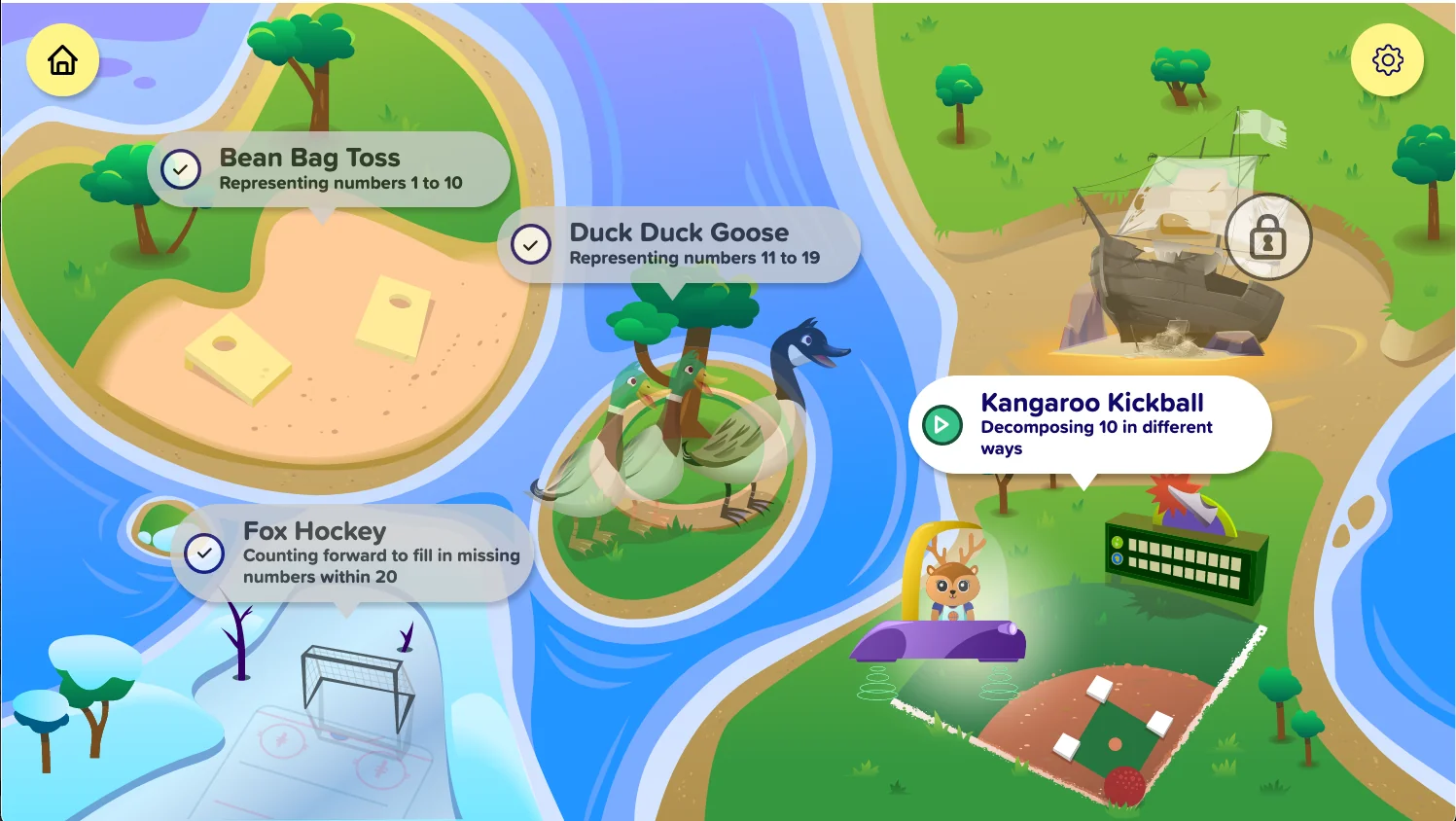
We've also been thoughtful in our approach to motivation. Rewards are incorporated throughout the program, which we know spark joy and motivate students to keep going. Nonetheless, we want to maintain a mastery orientation to their motivation. As students move through the program and watch their progress on the map, they can see their own growth in a straightforward metaphor, motivating them to learn simply for the sake of growing.

example of map showing links to ALEKS Adventure games

We know that math achievement gaps post-COVID persist. How does ALEKS Adventure help bridge those gaps?

Andrew: The efficiency of the Knowledge Space Theory behind ALEKS is what makes it so powerful – it moves students who have fallen behind quickly and efficiently through material. The Initial Knowledge Check shows teachers the specific skills and concepts that their students know and don't know. From there, the program sets them on the most efficient path to fill in their gaps, allowing them to work at grade level. Importantly, ALEKS Adventure also provides direct instruction – not just practice – which helps teachers personalize at scale.

Paul: We also include scaffolding for all questions, posing an alternate version of a question and encouraging students to try again. We were careful to address wrong answers in a tone that is thoughtful yet clear.

We were sure to create an experience that makes math accessible for emerging readers, pre-literate students, and English Learners. The animations are mathematically honest and ensure students can get the feedback they need through audio without removing the text. 

How did student and teacher feedback and testing factor into the ALEKS Adventure design process?

Scott: We conducted nonstop user research testing, more than a year before the program was available for alpha testing, that influenced our approach to art and storytelling. That feedback was so powerful for us because it challenged our assumptions about what teachers need and what students are ready for or enjoy.

Paul: User testing helped us refine our approach to student focus, tweaking what was presented on the screen to ensure students were paying attention to the right things. We also received feedback from teachers around  rewards that helped us dial back on extrinsic motivation and learn further into intrinsic motivation, which is an important balance for us to strike.

Andrew: Alpha testing also delivers us a tremendous amount of rich data – the user experience data, or what teachers and students didn’t say. All that rich interaction data helps us tweak the topics and knowledge structure to ensure students are getting the content they need and experiencing success. ALEKS makes decisions based on empirical evidence; it doesn't set down hard truths. It’s always changing and responding to student experience.

What do students love about ALEKS Adventure?

Paul: In a classroom observation I attended, students were working through a lesson that features a rabbit magician. It’s a bit of a mystery where things go in this rabbit’s hat, and it’s revealed at the end that there’s a baby rabbit inside the hat eating everything. I saw students flipping their laptops around to show this moment to their peers and laughing. We’re always looking to create those kinds of moments for students – where they want to disrupt their neighbors (just a little bit) because they find something so delightful. 

We checked in with Paul in the fall of 2026 to learn more about how ALEKS Adventure supports districts navigating a trending challenge: screen time restrictions. Paul, how is ALEKS Adventure designed to work for districts navigating a reduction in screen time for young learners?

Paul: We know screentime is a real and valid concern for administrators and families, especially with our youngest learners, so we built ALEKS Adventure differently from the start. A lot of programs assume students will spend long stretches online, but ALEKS Adventure lessons typically run just 10 to 15 minutes, and the adaptive assessments built into the program are deliberately brief and efficient. We're not trying to keep kids in the program for long blocks of time. The goal is to deliver personalized learning in short, focused bursts and leave teachers plenty of room for the conversation and collaboration that happens off-screen. 

The results hold up in that short window: we know that just 30 to 60 minutes of ALEKS per week is associated with more than 60% growth in student mastery of course content, and because ALEKS is aligned to each state's math standards from the start, that mastery growth translates directly into the outcomes districts are responsible for. So, districts can meet screen time limits and still see measurable academic growth.

But we've also learned that purposeful screen time isn't just about the clock, it's about what's happening during those minutes. Here’s what makes time spent using ALEKS Adventure different from other digital learning programs:

  • A lot of programs that look like ALEKS Adventure on the surface are really just serving up practice problems based on broad assumptions about what a student needs. Instead, ALEKS Adventure uses Knowledge Space Theory to build a precise map of exactly what each student knows and what they're ready to learn next, so learning is always happening right at the edge of a student's understanding. 
  • Screen time with this program is very active, not passive. Students construct their own answers rather than clicking through multiple choice, often using tools like number lines or graphs to show their thinking, and we encourage them to keep paper and pencil nearby as they work. They get instant feedback, and the program periodically revisits earlier material through short Knowledge Checks, so learning sticks instead of fading. 
  • Unlike some similar products, ALEKS Adventure offers students meaningful choice between multiple productive activities. That way, students are more engaged by the topics they’ve chosen, and they’re not stuck at a screen waiting for someone to help them. In many other products, when students encounter unproductive struggle, they have no escape hatch. ALEKS Adventure isn’t like that, and it means students' time with the program is more productive and more engaging.

So when a district asks how we think about screen time, that's our answer: make it short, make it purposeful, and make sure every minute is both delightful and meaningful.

Top